Senin, 16 Juli 2007

The Spirit of the Lord, §10.4: Logocentrism

Fourth, the vision of the New Jerusalem is logocentric. At the center of Mic. 4:1-4 stands the statement: “For out of Zion shall go forth instruction, and the word of the LORD from Jerusalem.” The organizing reality at the heart of Micah’s eschatological vision of the new community is the word of the Lord, the verbum Domini, the logos of God. The word is what comes down from the mountain of Zion to all peoples; the word is what arbitrates between strong nations, establishing the communio pacis and instructing the world in the ways of God’s law; and the word is the telos of the nations’ pilgrimage, the heart of the eschatological new creation. The vision of the ekklesia is thus thoroughly logocentric: the community identified by the covenant of peace is centered on the logos, the word which calls the community into existence and commissions the people of God for the ministry of reconciliation.

The word is primarily one of instruction in the ways of the Lord. The word of God is a prophetic word of divine wisdom that inculcates a new existence in accordance with the law (cf. Jer. 31). In Micah’s vision this pursuit of wisdom is no longer limited to a select group of people—an exclusive group of those who have received the word of the Lord—but rather all the nations declare their desire to “walk in his paths.” The word does not belong to any particular family, tribe, or nation; instead, the word goes forth as an event for all peoples, for every family, tribe, and nation. The word of the Lord is a speech-event in which the God of Jacob actualizes the law in the eschatological moment, thereby establishing justice between nations and peace among the people of the earth. In the eschatological event of divine speech, the telos of the law—“all the families of the earth shall be blessed” (Gen. 12:3)—is fulfilled in accordance with God’s eternal will: “for the mouth of the LORD of hosts has spoken.”

At its heart, the verbum Domini is a word of life. As instruction, the word is also liberation; as judgment, the word is also reconciliation; as imperative, the word is also indicative. The word is both declarative and creative at the same time. In that the word instructs humanity, the word constitutes a new human subject in correspondence to this speech-event. The word places a clear demand upon the human person who hears and receives this word, but the impossibility of obeying the word is rectified in the event of divine speech: “I will be with your mouth and teach you what you are to speak. . . . I will be with your mouth and his mouth, and will teach you what you shall do” (Exod. 4:12, 15). The divine event of the word thus actualizes the ontic reality of a new humanity in correspondence in God. The logos establishes the human person who hears, receives, understands, and responds to the verbum Domini (cf. Isa. 6:9-10, Matt. 13:13-17, 16:15-17; Jn. 8:47). The word of God is the act of God in which God “makes history in the supreme sense” (Barth, CD I/1, 144). The most concrete instance of this occurs in Ezek. 37, in which the prophet is commissioned by God—in fact, transported by the hand of the Lord—to prophesy to the valley of dry bones: “O dry bones, hear the word of the LORD. Thus says the Lord GOD to these bones: I will cause breath to enter you, and you shall live” (Ezek. 37:4-5). The word of the Lord is the operative agent throughout this passage, as the basis for both the prophetic utterance and the event of new life: “as I prophesied, suddenly there was a noise, a rattling, and the bones came together, bone to its bone” (Ezek. 37:7). The prophet is an acting subject who speaks, but it is the word of the Lord which constitutes this speech as divine speech and constitutes the dry bones as “a vast multitude,” the “whole house of Israel” (v. 10, 11). The word of the Lord is thus “living and active” (Heb. 4:12), and by in the event of the word Christ sustains “all things” (Heb. 1:3). The word pierces the heart and “divides soul from spirit” (Heb. 4:12), but it also restores, heals, and breathes new life into dead matter. The verbum Domini brings life out of death, bodies out of bones, breath out of the four winds, Israel out of the grave, and humanity out of hell.

The community of those called by this word is therefore a logocentric community: the ekklesia exists as a community constituted by the word, filled with the word, directed by the word, and ordered toward the word. The church is a creatura verbi, a communion constituted by the word as witnesses to the word. The church is a koinonia of those defined by the covenantal word of grace and who proclaim this word in faithful obedience to the missio communionis. At the center of the communio sanctorum stands the Word of God, Jesus Christ, who radiates his presence outward through Scripture, through the community, and into the world. The covenantal community testifies in word and sacrament to the Word at the center of the world. In the end, finally, we see in Micah that the Word is the center not only of the covenantal people of God, but also of the entire creation as the theater of the Word. This then is the mission of the ecclesial community: to bear witness to the fact that Jesus Christ, the true Logos of God, the Verbum Domini incarnate, has reconciled the world to himself, and consequently all of creation, whether it wishes to be or not, is constituted as the logocentric theater for the manifestation of God’s gracious will to be Deus nobiscum—God with us.

Sabtu, 14 Juli 2007

A theology of chocolate

I consider myself a connoisseur of many things: microbrews, pipe tobacco, foreign films, indie music. But recently I have been gravitating toward artisan chocolate. Not the stuff you buy at the supermarket. Not the bland, mass-produced Hershey’s bars (though I still love my Reese’s Pieces). Not sugar-injected chocolate that has lost any trace of the original cacao beans. No, artisan chocolates are to Hershey what microbrews are to Budweiser. They are crafted by small chocolate makers with unique flavors and ingredients.

I first realized that my chocolate palate was underdeveloped when I went to England in 2003. There I tried my first bona fide Cadbury chocolate bar. It was richer and creamery than anything I had ever tasted. Since then I have enjoyed the wonders of German, Swiss, Belgian, French, and more recently, Venezuelan chocolates, among others. This past week, the NY Times published a wonderful article on the greatness of Cadbury chocolate. The article notes the differences between American and British chocolate:
Mr. Smart, who has lived in the United States for 25 years, learned early on in his life here that British and American chocolate bars are different, even if they share a name and a look.

“One day I was eating a bar of Cadbury Dairy Milk and I thought, this has absolutely no flavor,” he said. “I looked at the label and saw it was made by Hershey. I was outraged.”

Cadbury Dairy Milk is the iconic British candy bar, the one most likely to be tucked into the suitcase of a Yankee tourist looking for an inexpensive souvenir. Versions are filled with caramel, whipped fondant, whole nuts or pellets of shortbread cookie.

It’s a different bar from the Cadbury bar available in the United States. According to the label, a British Cadbury Dairy Milk bar contains milk, sugar, cocoa mass, cocoa butter, vegetable fat and emulsifiers. The version made by the Hershey Company, which holds the license from Cadbury-Schweppes to produce the candy in the United States under the British company’s direction, starts its ingredient list with sugar. It lists lactose and the emulsifier soy lecithin, which keeps the cocoa butter from separating from the cocoa. The American product also lists “natural and artificial flavorings.”

In light of these differences, I would like to offer a few theses toward a theology of chocolate. As far as I know, such a project has never been undertaken before. I welcome help from others who are willing to explore the profound depths of chocolate.

A Theology of Chocolate

1. Chocolate is a gift of God. Like rainbows, manna, tobacco, beer, and coffee, chocolate is an expression of divine favor toward humanity. “Every perfect gift is from above, coming down from the Father of lights” (Jas. 1:17).

2. Chocolate is an event of human freedom accompanied by God (concursus dei) within the covenant of grace. Chocolate is not part of the original creation. The raw elements are found in nature, but human action had to bring these together in order to produce the glorious bar of chocolate that we now enjoy. While human autonomy often leads to the destruction and perversion of nature, chocolate is a testament to the divine accompanying of human action within the covenant of grace between God and humanity.

3. Chocolate is a christologically grounded reality. The Christ-event is an event which reconciled the world to God (2 Cor. 5:19). According to Ephesians, this event “has broken down the dividing wall” between Jews and Gentiles (Eph. 2:14); according to Galatians, all of us are now “one in Christ Jesus” (Gal. 3:28); according to 2 Corinthians, “everything has become new!” (2 Cor. 5:17). Chocolate is a manifestation of this reconciliation. Chocolate unites people from around the world in appreciation of its artistic and God-given taste; it carries on its own “ministry of reconciliation” (2 Cor. 5:18) by resurrecting dead taste faculties and offering nougat-filled glimpses into the grace of God.

4. Chocolate is a concrete manifestation of the coming eschatological kingdom. In the coming kingdom, the Lord will reveal the new heavens and new earth in which “death will be no more; mourning and crying and pain will be no more, for the first things have passed away” (Rev. 21:4). Chocolate is a taste of the coming regnum dei. In anticipation of what God will accomplish for all, here and now chocolate “wipes every tear from their eyes.” Chocolate is thus a proleptic realization of the New Jerusalem, which “has the glory of God and a radiance like a very rare jewel” (Rev. 21:11). In its own small way, chocolate ushers us into the presence of the eschatological community, where we will gather around the messianic banquet table and feast together as the one people of God.

Jumat, 13 Juli 2007

Providence reconsidered

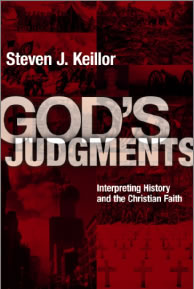
In the most recent issue of Books & Culture, Brad S. Gregory reviews the new book on divine providence by Steven J. Keillor titled, God’s Judgments: Interpreting History and the Christian Faith. The thesis of Keillor’s book is suspiciously ambitious: because the Scriptures describe certain events as divine judgment against sinful people, we are able on this biblical basis to discern certain historical events in the present also as God’s judgment against sin and evil. Keillor’s book is thus a sustained argument against the modern, scholarly discipline of history that discards the categories of divine judgment and divine providence from any interpretation of historical events. Modern historical scholarship forces historians to examine world events “as if they were deists or atheists, even if they believe that God acts in history.” Keillor sets out to reject through historical arguments this modern a priori repudiation of the traditional, Christian view of history in which God is the acting agent in contemporary events.

According to the reviewer, Keillor repeatedly denounces the “Christian worldview” mentality that is prevalent among Christian fundamentalists, such as Pat Robertson and the late Jerry Falwell. Keillor rejects this on the basis that it erects a quasi-philosophical system on the basis of the biblical text through which all reality can be interpreted exactly. Keillor is not quite so ambitious. But he nevertheless wishes to establish a median between philosophical exactness and modern practical atheism. Keillor seeks “to correlate known causes of the event with known categories of divine holiness and judgment” and thereby to identify certain events as caused by God as judgment against sinful people. Gregory summarizes Keillor’s position in the following way: “if God’s purposes are such and such, then certain events are plausibly understood as his judgments in the flow of human history.” As quoted by Gregory, Keillor writes in his book:
We must beware of presumption in claiming to know the mind of God. But the pendulum has swung to the opposite extreme, where the inability to know for sure morphs into a refusal to ask questions that cannot be known with certainty and then into a dismissal of the category of divine judgment.
This is certainly an ambitious and subversive book, but I am also deeply afraid of what Keillor is trying to accomplish here. God’s Judgments may be both one of the most interesting and one of the most dangerous titles to be released in a long time. I wish to briefly identify where I think Keillor’s proposal (on the basis of the review, not having read the book myself) is likely to be most problematic. My own thesis, in short, is that Keillor’s book wades into theological territory far too complicated and messy for a biblically-literate historian to successfully navigate. And since Keillor seems to be unaware of the theological issues at stake, this makes his proposal dangerous in that it obscures and/or ignores the theological positions he takes in the book without realizing it. In what follows I highlight areas that demand more careful theological attention.

1. What do we mean by “divine judgment”?

This is a serious question that requires careful theological investigation. Based on the book’s table of contents and Gregory’s review, it seems that Keillor views judgment as divine condemnation—the figurative “lightning bolt” from heaven. Judgment is apparently something that God does in history to curb sin and punish evil. The massive problem with this thesis is that it fails to think christologically. According to the New Testament, divine judgment is radically redefined in terms of the cross, in which sin was definitively judged. As Barth says, Jesus Christ is the Judge who was judged in our place and on our behalf. If we do not consider judgment from this vantage point, we will miss the point of divine judgment: to bring life and peace to the world. Divine judgment is not simply a No; it is also and more importantly God’s sovereign Yes.

To be fair, Keillor does attempt to think christologically. The sixth chapter of the book is auspiciously entitled, “History’s Meaning: The Son of Man in His Descent, Ascent and Return.” According to Gregory, Keillor identifies the Hebrew concept of mishpat, so that divine judgment is now a christological reality. With this, I agree wholeheartedly. But Gregory then summarizes Keillor’s view in the following way: “Beginning with the incarnation, God’s winnowing purposes in history are identical with Christ’s: those who believe in him and his gospel will be saved, those who reject him will be judged. This applies to nations as well as individuals, an idea nowhere rejected in the New Testament.” If this is an accurate reading of Keillor’s thesis, then I must reject it for two important reasons: (1) I know of no NT support for the notion that God judges unbelief in history, in addition to after the end of history; (2) divine judgment in both history and eternity must be identified with the judgment borne by Christ on the cross, and thus we cannot posit forms of divine justice which do not take Christ’s sacrifice ‘for us and our salvation’ into account. Regarding the judgment of nations, see my next point.

2. Judgment against nations but not individuals?

Gregory writes the following about Keillor’s book:
In three densely exegetical and theological chapters, Keillor develops his interpretive foundation. Central is the notion, pervasive in the Old Testament prophets, that God judges not only individuals, but nations—all nations, not only ancient Israel and its neighboring kingdoms—as part of his action in history. Keillor distinguishes clearly between divine judgments of individuals and nations; his book addresses only the latter, sensibly mindful of the implications of Luke 13:1-5.
I am very skeptical of the position being taken here. While Job and Luke 13 may cast doubt upon the notion of divine judgment of individuals, what is a nation other than an aggregate of individuals? It seems that Keillor’s argument depends on the reification of the abstract concept of “nation,” thus turning nation-states into objects of divine judgment abstracted from the individuals that actually constitute the nations. How can God judge nations without judging individuals? Furthermore, the move from ancient nations to modern nations seems quite problematic. We have no biblical calculus that will allow us to extrapolate from ancient nations to modern nation-states. More on this in the next section.

Moreover, I am not entirely sure that Keillor has really examined the biblical evidence. In the episode recorded in Luke 13, Jesus denies the assumption that the Galileans killed by Pilate had sinned more than others. He says instead (twice for emphasis), “No, I tell you; but unless you repent, you will all perish as they did. ... No, I tell you; but unless you repent, you will all perish just as they did” (Lk. 13:3, 5). The point of the passage seems to be twofold: (1) God does not judge certain individuals more than others, and (2) God judges everyone equally because sin is universal. The point is not that God does not judge individuals, but that God judges all individuals. As Paul writes in Romans: “all have sinned and fall short of the glory of God,” and “the wages of sin is death” (Rom. 3:23, 6:23). Furthermore, in John 9:1-5, there is another important episode with a blind man. The disciples ask Jesus who sinned, this man or his parents, but Jesus denies that sin has anything to do with his blindness. Instead, he says that “he was born blind so that God’s works might be revealed in him.” It seems to me that if divine judgment is anything, it is God’s sovereign determination to reveal God’s glory in the world—a revelation uniquely constituted by Jesus Christ. To limit divine judgment to a crude punishment for sin is to miss the bigger picture: God judges in order to bring glory to God, and this is true of the blind man even though sin is not the basis for this judgment. As in Luke 13, the point is that no person’s sin is greater than any other’s, but what John 9 shows is that God still works in the lives of individuals.

Keillor’s problem is that he views judgment purely in the punitive sense, and therefore to avoid the problems associated with individual sin, he turns to abstraction and applies judgment to nations. But we need to remember that divine judgment affects people on an individual basis, and the definitive judgment executed in Christ is not judgment in the abstract but rather personal, concrete, and effective for each person.

3. Does the Bible provide principles for divine action?

While Keillor realizes that we cannot circumvent Christ in our understanding of divine judgment, his proposal requires that he go beyond the biblical testimony in order to speak about God’s activity in the present. The Bible’s witness to what God has done is not enough; the Bible must also be able to inform what God is doing. In order to accomplish this, Keillor seeks to derive from the biblical testimony certain basic principles for how God acts in the present. The problem is that we cannot deduce principles for divine action. God cannot be reduced to certain patterns without replacing a personal deity with abstract concepts. Granted, Keillor tries to avoid creating a philosophical system or “worldview” from the Bible, but I am not convinced on the basis of the review that he is free from criticism on this point.

Keillor’s continual problem seems to be a turn to abstraction in order to solve theological problems. In this case, he avoids the concreteness and historical situatedness of Scripture by finding principles and patterns of divine action that he can apply to any situation. The problem is that patterns and principles are not themselves revelation; they do not give access into the mind of God. Certainly, we must affirm that God acts according to God’s self-determined character, but God’s self-determination is identified with a person, not a principle, and the person of Christ is a concrete reality who has one particular concrete story. Moreover, the ascended Christ does not accomplish a different kind of judgment here and now (or in the eschaton) than the one he bore upon himself at Golgotha. So unless Keillor wishes to understand the judgment carried out in Jesus Christ as a judgment against those who do not believe in him, I believe we are led to strongly question his account of divine judgment.

Keillor advocates what he calls the “scriptural view,” which is basically a soft version of the “biblical worldview” thinking that he disparages (and rightly so). His criticism of others is therefore just a self-indictment. While he may phrase his conclusions much more cautiously, he remains bound to the same method of moving from text to history, from biblical past to historical present. As I have tried to show here, his thesis depends upon major theological and exegetical presuppositions (e.g., punitive divine judgment of nations, emphasis upon OT narratives, Christ not as the judge judged in our place but as the one who judges unbelief), and if he is going to be confident enough to call his position the “scriptural view” then he better be able to back it up. Gregory’s main criticism is on this very point—particularly the perspicuity of Scripture that Keillor takes for granted (for him, at least)—so I will not repeat what he has already said very well.

4. An arbitrary God?

One of the biggest problems with Keillor’s account is a problem that Schleiermacher and a number of other modern theologians have had with certain conceptions of God—viz. the view of God as an aloof observer of history who only occasionally acts to intervene when things are not going right. While this is the view that seems to be held by most of the writers of the biblical text, it is nevertheless a view that needs to be greatly qualified if not discarded in order to make sense of the Christian faith. Two of the biggest problems include (1) an arbitrary God who acts for some but not for others, and (2) a God who is not in control of all creation but must instead intervene. Keillor, I think, is liable to these criticisms, among others. God in his account observes history but is not continually involved in creaturely reality. There is no doctrine of concursus dei, as far as I can tell, and this is a major oversight. God is simply a transcendent deity who, like the cosmic watchmaker, simply creates the universe and then lets it go undisturbed until a nation commits enough atrocities to deserve God’s wrath in the form of other historical events.

Keillor seeks to avoid the notion of God working through absolutely supernatural events, but his God is still just as arbitrary and aloof, even though God works through historical events. Why is God to be found in certain events but not others? Why is God involved in the attacks of 9/11 but not in the “terroristic guerrilla units against the Soviets” which Keillor says is a possible reason for 9/11? If God was involved in 9/11, is God also involved in the Iraq War? Certainly, God is not to be identified with evil, but there is no historical event that is wholly good or wholly evil. Even if we grant that some events are more in conformity with God’s character than other events, we are theologically misguided to assume that God is not involved in each and every event as the God who accompanies all human action in order to bring creaturely reality into conformity with the covenant of grace.

Along these lines, Gregory’s comments are right on target:
In addition, difficulties seem to arise when one endeavors to understand God’s judgments in a broader context of large-scale human suffering and sinfulness. According to Keillor, Scripture testifies that God judges sinful nations in the course of historical processes, which in American history can be discerned in major, tragic events such as the Civil War and 9/11. But it does not seem to follow (a) that all large-scale, calamitous sufferings of a nation or people can be convincingly interpreted as God’s judgment, or (b) that egregious, widespread sinfulness in a nation predictably provokes God’s judgment in any obvious way, or (c) that the absence of major, tragic events at any given time implies God’s favor toward a nation rather than his wrath.

As examples of each, consider (a) the suffering endured for decades by citizens of African nations brutalized by postcolonial dictators, despite the simultaneous, rapid growth of African Christianity; (b) the treatment of southern blacks by whites in the United States, which remained atrocious for a century after the abolition of slavery, despite the lack of any cataclysm seemingly condign to the sinfulness; and (c) idolatrous American consumerism and immorality, which were no less rampant in the late 1990s than they were on September 11, 2001, yet the lack of any calamity in the 1990s cannot have implied (if Keillor’s interpretation is correct) that up until that day God was smiling on the United States.
5. Number idolatry

Following the previous quote, why must judgment be found only in “major, tragic events”? Keillor’s book assumes that God can only be identified with national/global events that involve many, many lives. I call this “number idolatry” and it is an idolatry that plagues our world today. This problem also goes back to the issue of God judging nations but not individuals. Why is God involved only when thousands of lives are at stake, but not when just one life is on the line? We see number idolatry whenever we have a major natural disaster. People around the world ask where God was in the tsunami, but they do not ask where God was when the teenager in Philadelphia was shot by the local gang or when the Californian family lost their father in a car accident. Why do ten thousand lives implicate God, but not one life?

6. Conclusion

Why do we need this book? If Keillor realizes the dangers of a system that informs us exactly where God is involved, then why are his cautious identifications of historical events with divine judgment at all helpful? What are we supposed to gain from the association of certain major events with God’s wrath? If we are supposed to gain a more potent awareness of our own guilt, then it seems that this can and should be gained without recourse to God. Are we incapable of seeing our own sinfulness unless we identify some tragic event as God’s judgment of our prior actions? Is this book simply an attempt to demonstrate how current events are similar to biblical events, as if to say, “Look, we are not any different than they”?

In the end, I fail to see what this book accomplishes except to mislead people on major doctrinal, theological, and exegetical issues. Keillor’s book is brazen and bold, but in the final analysis, only a “major, tragic event.”

Kamis, 12 Juli 2007

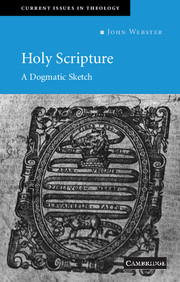
Webster: the clarity of Holy Scripture

Scripture is self-interpreting and perspicuous by virtue of its relation to God ... The clarity of Scripture is a function of its place in the divine self-demonstration, and of the Spirit’s work of ordering the mind, will and affections of the reader towards what Calvin called ‘heavenly doctrine’. Perspicuity only makes sense when seen in a soteriological context, that is, in relation to God’s act as Word and Spirit and the creature’s act of faith. Like other properties of Scripture, such as sufficiency, efficacy or perfection, clarity is not a formal or natural property of the text considered in isolation. ... Rather, Scripture is clear because through the Spirit the text serves God’s self-presentation. Properly speaking, it is not Scripture which is self-interpreting but God who as Word interprets himself through the Spirit’s work. ... Scripture is clear because of the Spirit’s work in which creaturely acts of reading are so ordered towards faithful attention to the divine Word that through Scripture the light of the gospel shines in its own inherent splendour. Perspicuity is thus not a way of suggesting that reading is superfluous; it is about the way in which faithful reading within the economy of revelatory grace is not sheerly spontaneous but a receptive act of the intelligence of faith. ... In sum: Scripture’s clarity is neither an intrinsic element of the text as text nor simply a fruit of exegetical labour; it is that which the text becomes as it functions in the Spirit-governed encounter between the self-presenting saviour and the faithful reader. To read is to be caught up by the truth-bestowing Spirit of God.
—John Webster, Holy Scripture: A Dogmatic Sketch (Cambridge: Cambridge UP, 2003), 93-95.

Rabu, 11 Juli 2007

Michael Behe: the limits of evolution

In their latest issue, Books & Culture has an excellent review of Michael Behe’s new book, The Edge of Evolution: The Search for the Limits of Darwinism. Behe’s book seeks to clarify misunderstandings about Darwinism commonly held by both evolutionists and by anti-evolutionists. Three things are associated with evolution: (1) natural selection, (2) common descent, and (3) random mutation. Behe fully supports (1) and (2) and argues that evolution can account for these better than any other scientific theory, which immediately makes him an enemy of creationists. But Behe sees scientific and mathematical limits to (3), and thus strongly argues against the views of Richard Dawkins. I definitely recommend the review. While long, the author summarizes the material well.

Senin, 09 Juli 2007

The Heresies of American Evangelicalism, Part VII: Ecclesiology

Part VII: Nationalism, or Depoliticized Discipleship

My original title for this essay in my series on evangelical “heresies” was “a Constantinian doctrine of church-state relations.” I am well aware of the problems that beset my topic before I even begin writing: (1) that to call a modern evangelical position “Constantinian” is anachronistic, since the era of Constantine and Christendom is historically distinct from the contemporary political scene; and (2) that Constantinianism and nationalism are not heresies, in any official sense. The former problem precipitated the change of this post’s topic from church-state relations to nationalism, which is more accurate anyway, since the problem is not how church and state are related so much as how the church views the state. Hence, the problem is not political as much as it is ideological. What justification do I have, then, for calling nationalism a modern American heresy?

I. Cavanaugh, Barth, and the First Commandment

The basis for my identification of nationalism as a modern “heresy” of American evangelicalism is rooted in the first commandment: “I am the LORD your God, who brought you out of the land of Egypt, out of the house of slavery; you shall have no other gods before me” (Exod. 20:2-3). Nationalism is not a heretical position; it is rather an idolatrous position, which is substantially worse than heresy. Arius and Pelagius may have been wrong, but they certainly were not idolaters, at least in terms of their theological positions. Nationalism, however, is an idol. Technically, therefore, it belongs in its own series on modern idols. But throughout the history of theology, the church has taken a clear stance on the relation between church and state such that nationalism has in various ways been established within the church as an official aspect of the Christian life. Where nation-states have official churches, this nationalism is simply expected. In modern America, however, the situation is more complex. Here the idol of nationalism (among other ideologies) is freely chosen and has become engrained in the cultural consciousness of evangelical Christianity. I speak of nationalism thus as a modern heresy because this cultural aspect of the church’s life has become normalized, even established doctrinally, such that the distinction between one’s confessional identity and one’s national identity is blurred. I will explore this problematic dimension of contemporary evangelicalism by looking at the first commandment.

In July 2005, William Cavanaugh gave the keynote address at the summer gathering of the Ekklesia Project. He lectured on the topic of American imperialism with the title, “The Empire of the Empty Shine.” His thesis is that by enforcing an empty shrine—i.e., having no national religion—nations like the United States end up enshrining themselves. Central to his thesis is the first commandment in Exodus 20:3. Cavanaugh argues, on the basis of this commandment, against the false notion of a neutral public space in which all gods are set aside for the sake of a rational, democratic state. Instead, the denial of a religious god only opens the door to another kind of god, be it economic or political or some other ideology. In America, for example, “the empty shrine … threatens to make a deity not out of God but out of our freedom to worship God. Our freedom comes to occupy the empty shrine.” Cavanaugh ends his talk by urging the church in America to abide by the first commandment, rather than allow any other god than the triune God of the Christian faith to occupy that shrine.

Many years before Cavanaugh, Karl Barth wrote his 1933 essay, “The First Commandment as an Axiom of Theology,” in which he argues that the first commandment is “the presupposition of all theology,” in that the indicative, “I am Yahweh your God,” and the imperative, “You shall have no other gods before me,” set the parameters for the theological task. The first commandment is not a statement that can be proven by other statements but is rather the sole starting-point for all theological thought. The first commandment ensures that the shrine is never filled by some cultural god, but rather that the church is wholly centered upon the triune God revealed in Jesus Christ. According to Barth, the first commandment is thus the starting-point for all theological reflection. But I argue that it is also much more than this. The first commandment is the starting-point for the very life and identity of the church; it is the basis, the presupposition, for our existence in a world dominated by false gods. Without the first commandment at the center of our life, we open the door wide to innumerable false deities waiting to fill the empty shrine.

What complicates the situation in contemporary evangelicalism is the way modern Christians attempt to make nationalism and worship of the triune God into complementary realities: obedience to God requires obedience to the nation-state, even adherence to a particular set of ideological positions. The basis for this mistake—the reason such a grave mistake could be so widely propagated and accepted today—is found in the de-politicization of the first commandment. When the command “you shall have no other gods” is turned into a purely spiritual, internal decree, then one’s sociopolitical allegiances are unaffected. When the confession of Jesus Christ is stripped of its subversive politics, in which only he is Lord and no other, then we end up turning what Christ himself condemned—viz. serving two masters—into a religious norm.

The only way to combat these disastrous misunderstandings of the Christian faith is to undermine the foundation upon which they rest. This can be done in two ways: (1) demonstrate that the division between spiritual and bodily, between faith and ethics, between “internal” and “external” is in fact a false (even heretical) dichotomy; or (2) like Cavanaugh, demonstrate the sociopolitical import of the first commandment. I take the former approach in my series, “The Spirit of the Lord,” while I will take the latter approach here.

II. The Politics of Exodus

The first commandment is situated at the turning-point of Exodus, between Israel’s bondage in Egypt and their new life as the covenant people of God. The first half focuses on God’s liberation of Israel from their bondage in Egypt (chs. 1-18), and the second half focuses on the formation of a new Israelite identity, centered on the cultus (chs. 19-40). The movement from the first half to the second half is a movement from slavery under Pharaoh to worship of Yahweh, from imperial oppression to divine covenant, from sociopolitical subjugation to sociopolitical community. Both sides of the narrative are political in nature: Egypt represents political idolatry, whereas Sinai represents a new political order of justice, peace, and worship.

We further see the political import of the first commandment (20:3) from its immediate context. The first commandment is introduced by a prologue (20:2) that recapitulates the history of redemption in which God acted graciously and sovereignly on behalf of the chosen people. The prologue connects the commandments to two distinct narrative frameworks—the past narrative of oppression and the future narrative of obedience, the past narrative of death and the future narrative of life. The prologue thus looks backwards and forwards; it is both anamnestic and proleptic. By reminding the people of Israel of their sociopolitical past, the prologue orients them toward the vision of a divinely ordained sociopolitical future—a future that comes to them as divine gift rather than as human repression. Put simply, if “the theological claim of the Prologue is a political announcement” (Patrick Miller), then the first commandment is a political imperative: “You shall have no other gods before me.” And “god,” as Luther understood, is simply that “upon which you set your heart and put your trust.”

The narrative of liberation becomes the norm for the social and political shape of the covenant. Exod. 22:21-24 commands fair treatment of foreigners and the poor members of society by reminding Israel of their own treatment at the hands of Pharaoh: “for you were sojourners in the land of Egypt” (Exod. 22:21). Israel’s anamnesis of God’s deliverance in the past not only conditions their social hospitality; it also establishes an ethic of economic hospitality that corresponds to God’s gracious provision for Israel in their state of poverty (cf. Exod. 12:35-36). In the subsequent verses in Exodus, the Lord commands Israel to not exact interest, but rather to establish justice among the people. The rationale for both the social and economic aspects of the law is the remembrance of the past narrative in which Israel cried out to God and God answered them. Finally, fidelity to the first commandment is the prior condition—the axiomatic presupposition—for obeying all other laws: “Be attentive to all that I have said to you. Do not invoke the names of other gods; do not let them be heard on your lips” (Exod. 23:13).

In addition to the prologue in Exod. 20:2, the first commandment is introduced by one other important passage in Exod. 19:4-6, where we read the words of the Lord to Moses: “You have seen what I did to the Egyptians, and how I bore you on eagles’ wings and brought you to myself. Now therefore, if you obey my voice and keep my covenant, you shall be my treasured possession out of all the peoples. Indeed, the whole earth is mine, but you shall be for me a priestly kingdom and a holy nation.” The summary of God’s liberation of Israel and the now which begins God’s promise to Israel indicates “that Egypt is now past tense to Israel” (NIB Commentary, 834): Israel is freed from the past and freed for the future, from oppression and for obedience, from the nations and for a new beginning as a “holy nation.” God’s speech to Moses in Exodus 19 is “programmatic for Israelite faith” and functions as a kind of prologue to the prologue, in that these verses express Israel’s divinely ordained identity while the Decalogue that follows in Exodus 20 fleshes out the nature of this identity.

The identity of Israel according to Exod. 19:4-6 is clearly a theopolitical identity shaped by the liberating event of the exodus from Egypt. Israel is constituted as the people of God who have a particular sociopolitical existence because of the particular God that they have—a God who is not satisfied with personal piety when there is social injustice, a God who takes up the cause of the poor and the oppressed, and a God who commands obedience in social and political matters in accordance with the covenant. Israel is not freed from oppression in order to oppress others; this would be a rejection of the God who freed them in the first place. Fidelity to the Lord of Hosts entails fidelity to social justice: orthodoxy entails orthopraxis. The lex credendi and lex orandi entail the lex amandi. Israel is only liberated by God in order to be a people who radiate God’s liberating love to others. Israel was taken up on eagles’ wings solely because of God’s gracious election of Israel, and consequently they are given the responsibility of living in correspondence to their elect identity both locally and globally—in relation to the neighbor and the nations of the world. We should note that these three verses make it clear that “the whole earth” belongs to the Lord, but that God choose Israel to be God’s covenant people. God elected Israel for a new sociopolitical identity in which the poor are no longer exploited, the hungry are fed, the naked are clothed, the oppressed are protected, and the foreigners are welcomed with open arms. This is what it means to “obey my voice and keep my covenant”; this is what it means to be “a priestly kingdom and a holy nation.”

My argument is that the first commandment establishes the political identity of the covenantal community. The Exodus account does not distinguish between inner and outer, spiritual and physical. The covenantal stipulations are extrospective rather than introspective: they turn us outward toward the neighbor in love and service. The commandments place a holistic and total claim upon our lives, without thereby becoming totalizing and absolutist. The Decalogue encompasses our sociopolitical life within the covenantal relation to Yahweh without calcifying the form such life must take. In its plainest sense, therefore, the first commandment demands complete fidelity to the Lord who graciously liberates, protects, and provides, and thus abuse in one’s “horizontal” relation to any neighbor is a disruption of one’s “vertical” relation to the Lord with whom one exists in a covenant of grace. The first commandment concerns proper worship of God, but God is not worshipped when the neighbor is not welcomed. Love of God and love of neighbor—and as Jesus reminds us, our neighbor might also be our enemy—thus implicate each other: you cannot have one without the other. The command to have no other gods before or in place of the Lord is a command to tear down whatever barriers we might erect between ourselves and the Other.

III. The Ekklesia and the Nation-State

I take it as axiomatic that the covenant of grace between God and Israel applies to the ecclesial community as well. The church is part of the same covenantal community conditioned by the same covenant of grace grounded in Jesus Christ. The foundations of Israel are foundations for the church as well and vice versa. Furthermore, the exodus from Egypt now extends to all people because of the liberating event of the cross in which Christ freed all humanity from the pharaonic powers of sin and death. Similarly, the responsibility to live in correspondence to this covenant extends to all people; God calls the whole of humanity to peace, justice, and righteousness. Certainly, the ethic we find in the gospels and epistles transcends the specific legal stipulations established in the Old Testament law codes. But the new ethical framework established by Jesus and Paul does not undermine the sociopolitical ramifications of the covenant; on the contrary, it radicalizes them (cf. the Sermon on the Mount). More importantly, the ethical framework of the church remains grounded in the same God of grace who establishes the same covenant of grace—it is a “new covenant” only in that it universalizes and radicalizes the redemption that God graciously began with creation and constituted in Christ.

That said, how ought the ecclesial community relate to the nation-state? Or, more personally, how ought the Christian relate her ecclesial identity to her national identity? Or, as Cavanaugh often puts the question, what is the relation between being a Christian and being an American? To really due justice to these questions would take us too far afield. By framing these questions in terms of the first commandment, I have sought to focus the question on the issue of idolatry. American evangelicals are predisposed to see idolatry in things that they already view as morally reprobate, such as sexual “deviancy” and drug addiction. But as any cursory glance at Exodus demonstrates, the problem of idolatry is thoroughly political. The rulers of Israel and Judah in the divided kingdom are identified as idolaters, because they perpetuated the reign of Pharaoh by oppressing the poor and ignoring social injustices. The covenant law was established by God in order to prevent the continuation of Egypt in their midst; the Decalogue was given by God so that Pharaoh might no longer exert his dominion of unrighteousness and injustice. The fact that the Israelite leaders became their own Pharaohs helps explain God’s wrath as recorded in the prophets as a recapitulation of the divine wrath executed against the Egyptians. My point is simply that one’s sociopolitical identity is basic to the question of idolatry. Idolatry is fundamentally corporate and political in nature, and thus righteousness is also corporate and political.

What I find most problematic about American evangelicalism is thus the clear lack of a covenant ecclesiology. Of course, evangelicals generally lack an ecclesiology altogether, and this plays itself out in evangelical engagement in politics. Without a robust ecclesiology in which believers are defined in relation to the church as the covenantal community in fellowship with Christ, evangelicals are free to decide ad hoc—in accordance with their own interpretation of Scripture—what are the sociopolitical implications of the gospel, if any. The lack of an ecclesiology allows the church to become an aggregate of individual believers rather than a community defined by the covenant of grace and called to bear witness to the world with a concrete sociopolitical existence. Consequently, American evangelicals tend to view their American identity in political terms, while viewing their Christian identity in spiritual and invisible terms. Evangelicals are thus too often guilty of neutering the church, rendering it empty of sociopolitical relevance in a world all too happy to see churches affirm and prop up the established structures of oppression rather than confront them with a Christ-centered insurgency.

There are (or at least were) many evangelicals who talk as if being a Christian and being an American are complementary realities. The assumption seems to be that one’s Christian identity determines how one lives spiritually while one’s American identity determines how one lives physically and materially in the world. Being a Christian means that one worships God and proclaims the good news of the gospel to others, while being an American means that one adopts the values and ideals which most promote life in this country. One pledges allegiance to God as a spiritual being and pledges allegiance to the flag as a sociopolitical being. Such compatibilism is only possible, of course, if one neuters the gospel’s political ramifications. Being a Christian cannot have any social or political implications but must instead be a purely individual, spiritual identity that can be freely joined to whatever national politic one deems best.

Things are, of course, quite a bit more complicated than this, of course. Many evangelicals today are well aware that the Christian narrative calls us to a particular way of life. It just so happens that they think the gospel endorses the Republican platform and calls them to serve their nation just as loyally as they serve the Christian church. Sexual ethics—viz. abortion and homosexuality—form the cornerstone of evangelical politics, while other issues are resolved in a more ad hoc manner. For example, many evangelicals have adopted a concern for the environment as part of a pro-life agenda, and some have also joined the ranks of those criticizing the militarism of the Bush administration.

The problem nowadays is not so much the denial of politics, but the assumption that one particular kind of politics is in conformity with the gospel. And not just any particular politics, but a particular national politics. In other words, most evangelicals still seem to think that the United States government sets the terms for what is properly political. Hence, evangelical politics are still bound to the two-party system, a reality that is evident not only in the strict separation between the Religious Right on one side and Jim Wallis on the other but also in the dichotomous rhetoric that divides people along the lines of liberal/conservative, left/right, pro-America/anti-America, ally/enemy. As long as evangelicals take their political cues from national politics rather than from Scripture, the evangelical engagement in social issues will remain at least potentially, if not actually, idolatrous.


A covenant ecclesiology recognizes that the ekklesia and the nation-state are both political bodies with their own allegiances. The ekklesia is a sociopolitical body defined by the covenant of grace and constituted by the person of Jesus Christ; the nation-state is a sociopolitical body defined by its constitution and constituted by its citizens. The church commits idolatry whenever its evangelical mission becomes intertwined with the nationalistic mission of the nation-state (which is often an imperialistic and capitalistic mission as well). The church commits idolatry whenever both Jesus Christ and the flag are considered worthy of allegiance, perhaps not equally but nevertheless in some sort of compatibilist framework that neutralizes the identity of Jesus Christ as Lord and King, and attempts to coordinate one’s citizenship on earth and in heaven. The church commits idolatry whenever Christians attempt to serve two masters—not only God and Mammon, but also God and America (or God and the Nation). The imperatives that Christ gives to the church—“take and eat; this is my body” (Matt. 26:26); “go therefore and make disciples of all nations” (Matt. 28:19)—are political imperatives: they are a call to cruciform discipleship that pledges allegiance to Christ alone (solus Christus) and submits in humble obedience to the beckoning call of the Master: “Follow me.” Any attempt to conjoin the call of Christ with the call of Uncle Sam—thus depoliticizing discipleship and baptizing citizenship—is an act of idolatry parallel to the Israelites who could not stomach a holy and mysterious God and so bowed down instead before a calf of gold—a god they could domesticate, manipulate, and fit comfortably into their everyday lives.

As the covenantal community of the triune God, the ekklesia has a theopolitical identity shaped by the liberating event of the cross. We are not defined by any particular nation, because the community of Jesus Christ is a catholic community; there are no borders within the church, no boundaries to the worship of God. The ekklesia is a community that bears witness to the God of all grace who universally unites humanity while grounding us in the concrete and local, who demands justice here and now while rectifying injustice there and then in the resurrection, who calls a particular people to be a light to the world while becoming the incarnate Light of the world in Jesus Christ. In its historical embodiment of the eschatological kingdom, the ekklesia is a subversive witness to God’s present and coming reign. The ekklesia thus stands over against the nation-state: the ekklesia says No to the claims of the nation-state and Yes to the claims of Christ, No to nationalism and Yes to the worship of God.

In conclusion, the relation between the nation-state and the ekklesia is both antagonistic and affirming. The relation is antagonistic in that the ecclesial community witnesses against the idolatry of the state that continues to perpetuate Pharaoh’s oppressive reign through systemic violence, economic bondage, and social subjugation. The relation is affirming in that the ecclesial community joins in itself the nations of the world that will one day gather around the mountain of the Lord in worship of the triune God (cf. Mic. 4:1-4, Rev. 21:24-26). The church must be fully aware that their identity as the church, as those who follow Christ in humble obedience, calls them to witness with their lives to a coming eschatological community in which justice, peace, and love will reign for eternity. Here and now, the ecclesial community cannot assume that their witness will be compatible with the claims of the nation-state. Instead, Christians must be aware that the command of Christ may call them to publicly confront the political idolatry of the state that has been and continues to be so prevalent in our modern age. In so challenging current social structures, the ekklesia may find that they are being truly conformed into the likeness of Christ, the one who died at the hands of idolatrous imperial power for us and our salvation. Let us remember that the first commandment is not only the “axiom of theology,” as Barth rightly notes, but it is also on a fundamental level the axiom of the ekklesia.

The world according to John Wilson?

John Wilson, editor of Books & Culture, has written another unnecessarily harsh and unfair review of a book, this time the politically charged new book by Charles Marsh, Wayward Christian Soldiers: Freeing the Gospel from Political Captivity, in which Marsh states: “The partisan captivity of the gospel in the United States is the gravest theological crisis of the Christian faith in our time.” I happen to think Marsh is quite right, but Wilson does not. Why? Simply because it does not conform to the world that he himself sees around him:
For myself, only very intermittently does the world Marsh describes correspond to the world I know. Neither at the church where Wendy and I worship—Faith Evangelical Covenant in Wheaton, where partisan politics is strictly off limits—nor in the evangelical circles I'm familiar with across the country do I see anything resembling the pervasive “political captivity” of the gospel that Marsh indicts. I do see evidence of the distortions he identifies in the pronouncements of some prominent evangelical figures, but—in my experience—the influence of such attitudes is far less dramatic than he suggests.
I suspect Wilson is just blind to the ways the evangelical world he inhabits is thoroughly bound to partisan politics. But for now I will accept that his world is miraculously free of such problems. His partisan-free existence aside, Wilson cannot then conclude that Marsh’s argument is simply wrong or misguided. At the very least, charity demands that he evaluate Marsh’s arguments on their own terms first before dismissing them as irrelevant to the world we actually live in. For that matter, Wilson apparently has never visited the town of Portland, Oregon where I grew up, and where partisan evangelicalism runs rampant—though curbed recently due to a new generation fed up with their parents’ attitudes toward politics. If Wilson wants more evidence for a different kind of world than the one he (apparently) knows, then he can just read yesterday’s New York Times, in which there is a fascinating story about evangelicals evaluating the current field of G.O.P. candidates. In the story, we read:

Mr. Giuliani’s candidacy was similarly a nonstarter with him, he said, because of the former New York City mayor’s support for abortion rights.

“Abortion is still number one with me and every social conservative I know,” Mr. Pawlewski said.

But Michael Canady, a board member for the Iowa Christian Alliance, said he was at least open to voting for Mr. Giuliani, arguing his strong stance on terrorism could trump other concerns.

“He’s definitely more liberal on the social issues than most evangelicals like,” he said, but he added that he considered Mr. Giuliani “a leader and somebody who could be strong on defense.”

With many Christian conservatives intent on preventing a Democrat from being elected, perhaps the biggest quandary for many is whether electability should be paramount, or whether to stick to a candidate who most shares their faith and worldview. ...

Most of the 40 evangelicals interviewed for this article, however, said they were not interested in throwing away their vote, saying Mr. Giuliani would be preferable to any Democrat.

There is a lot about this article worth pondering, but at the very least it gives a glimpse into the deep partisanship of conservative evangelicalism. Like many Christians I know from my home town, it is more important to keep a Democrat out of office than to elect the best candidate. For such people, preventing the death of unborn children is infinitely more important than the deaths of born men, women, and children around the world—often at the hands of American soldiers. Personally, I would not just call this partisanship; I would call it idolatry.