In his third Warfield lecture, David Kelsey turned to the question of divine sovereignty. His entryway into this question is the doxology of the Lord’s Prayer: “For the kingdom, the power, and the glory are yours, now and forever.” He briefly discussed the history of this doxology and noted that it was originally situated in the context of catechesis. Even though it is a late addition to the prayer, it serves, according to Kelsey, as an ancient creedal formula. It is as much a confession about God as a prayer to God.
However, we immediately confront a problem regarding the language of “kingdom.” For starters, it does not seem to parallel the other two terms, power and glory, because it is not intrinsically relational in nature. A kingdom seems to be a static entity or location, not an active relation to creatures. Furthermore, the term has sexist and oppressive connotations. An earthly king is understood to be someone who exercises absolute power over his subjects, which leads to many problems if ascribed to God by analogy. To deal with these problems, Kelsey reorders the doxology as glory, kingdom, and power. By placing glory first, he intends to define the identity of the one who exercises sovereign power. God’s power is understood in light of God’s kingdom, and both are understood in light of God’s intrinsic glory.
Kelsey then turned to address “where sovereignty is definitively expressed”—in what he calls “eschatological consummation.” In order to understand this term, we have to recall the three kinds of canonical biblical narratives that Kelsey takes from Claus Westermann. The first type of narrative is “liberative promises,” which refers to episodic accounts in which God acts to liberate the people from an oppressive situation. The exodus is obviously the paradigmatic instance of this. The second type is “creative blessing,” which refers to a “steady-state” blessing and sustaining of creaturely existence in itself. This is rooted in the creation narratives: “And God saw that it was good.” The third type is “eschatological consummation” or “eschatological blessing,” which is an additional blessing in excess of creative blessing that brings about the flourishing of the creature.
Eschatological blessing is “coeval” with creative blessing (narratively expressed in the establishment of the Sabbath on the seventh day), but it is not the latter’s logical ground or telos. It’s important for Kelsey that we give creative blessing a kind of independent significance; it has no necessary connection to salvific liberation or eschatological consummation. When creative blessing only exists as a presupposition for eschatological consummation, then it implies that we are not fully creatures until consummation. There is, therefore, an asymmetrical order between creative blessing and eschatological consummation. The latter presupposes the former. Eschatological blessing is an excess, a gift, a blessing-upon-blessing.
Finally, Kelsey made some remarks about why we necessarily “stammer” about God. He provided three basic reasons. First, because divine agency is radically unlike any form of creaturely agency, such that no analogy exists to adequately articulate God’s sovereign rule. God is able to be both immeasurably distant and immeasurably near to us at the same time in a way that we can never truly grasp. Second, the three kinds of canonical narratives noted earlier cannot be synthesized into a systematic unity. Each has its own concretely singular logic. Third and finally, we stammer due to the mysterious simultaneity and distinctiveness of providential care (creative blessing) and eschatological rule (consummation). These two forms of divine agency do not logically necessitate each other, and yet they are both simultaneously grounded in the glorious power of God. Both are aspects of God’s sovereign self-determination. They are consistent expressions of God’s own intrinsic glory.
Finally, in the Q&A following the lecture, it was asked whether Kelsey is an infralapsarian. He responded that he is a kind of supralapsarian. Eschatological blessing is not made necessary because of human sinfulness. It precedes the fall within the creation narrative, and thus such consummation would have occurred even had we not sinned. The incarnation of Christ would, in such a speculative possibility, also have taken place as part of God’s consummation of the creature. But because of the sin problem, such consummation also addresses the need for redemption.
Tampilkan postingan dengan label creation. Tampilkan semua postingan
Tampilkan postingan dengan label creation. Tampilkan semua postingan
Selasa, 05 April 2011

Rabu, 23 April 2008
Four theses against Intelligent Design
 The new film, Expelled: No Intelligence Allowed, by Ben Stein was released into theaters last week. The movie, according to the film’s official synopsis, “uncovers a long line of scientists and philosophers who have had their reputations destroyed and their careers ruined by a scientific establishment that allows absolutely no dissent from Charles Darwin’s theory of random mutation and natural selection.” The movie tries to make the claim that we live in “a nation today in which scientists are being silenced and ousted, in which teachers and professors teach a theory as indisputable fact.”
The film tries to portray Intelligent Design (ID) as a valid scientific alternative to the theory of evolution. I have not (yet) seen the movie, so I cannot make any declarations about its quality. (There is already a website called Expelled Exposed that does a very fine job of “debunking” the claims that Stein makes in the movie.) What I will do here is instead present a brief case against ID. I view ID as a dangerous piece of anti-Christian idolatry, one that can only do harm to the church. In what follows, I present four theses. I do not claim to be an expert on this subject. I approach this matter as a theologian, and it is as a theologian that I reject ID.
Thesis #1: Comparing Evolution and Intelligent Design is a category mistake.
The official summary of the movie, along with just about everyone in the debate (particularly on the ID side), implies that ID and evolution are two opposed positions. Each stands over against the other. Ben Stein wants to make the point that evolution is just a theory, but that scientists treat it like fact. He wants ID to be another viable option in the scientific community. There are two problems with this view.
Thesis 1.1: Evolution concerns the development of complex life, while ID concerns the origin of complexity.
Evolution as a Darwinian theory says nothing about why there is life on this earth. It makes no claims about why there is something rather than nothing. There are various other theories about how life came to exist on this planet (e.g., Primordial Soup Theory, Deep Sea Vent Theory, Eigen's hypothesis, Wächtershäuser's hypothesis, radioactive beach theory, etc.). Such theories are independent of the theory of evolution. One can discard all of those theories and still believe that evolution is the only sufficient answer to the scientific evidence about the development of complex life forms.
Technically, ID supports the theory of evolution, in that it says nothing about it. Michael Behe, for example, makes it very clear in his latest book that evolution is essentially correct. Against creationists and most religious ID supporters, he argues that the earth is billions of years old and that the concept of common descent is correct. His support of ID is, in fact, grounded in and develops out of his support of evolution. ID’s real beef is with origin of life theories. ID wants to say that current theories cannot fully account for how complex life began—and thus God or some abstract being or an alien creature has to be brought into the picture at some point. I’ll return to this later. My point is that a comparison of evolution with ID is a category error. It is a comparison between apples and oranges. ID supporters are thus foolish for trying to make their position appear to be an alternative to evolution, as if the two stand over against each other. That is simply not the case.
Parenthetically, one should notice that this line of argumentation could actually help ID! Part of the problem is that by arguing for ID over against evolution, supporters end up unnecessarily picking a fight. Moreover, it is a fight which ID should not be fighting (because of the category error). That said, there is a very good reason why ID supporters want to pick this fight, but it has nothing to do with the substance of their proposal and everything to do with their attempt to gain scientific legitimacy for their position. They realize that if they do not portray themselves as an opponent to evolution, then they lose the central aspect of the whole debate; ID becomes a superfluous side conversation, rather than the main event. It’s all about gaining recognition.
Thesis 1.2: Evolution is a scientific theory while ID is not.
If in thesis 1.1 I made the claim that comparing evolution and ID is like comparing apples and oranges, then here I claim that ID is not a fruit at all. This is also well-supported, though far more controversial. The problem is quite simple: evolution is a testable theory, while ID has given us no testable scientific hypothesis that can be evaluated in the lab. Whereas evolution can and has made testable predictions about what we should find in the world, ID makes no such predictions. ID offers no hypothesis, no theory, no experiment. It is, in other words, non-scientific. ID cannot even claim to explain the origin of the complexity; it only claims that the complexity is too complex to be explained internally, i.e., within the bounds of the natural world. ID does not say what external agent is the cause of such complexity, nor what the nature of this agent is, nor what consequences such an agent may have for future scientific research. It only states that there must be some such agent. This is a non-scientific claim, since the classical definition of science requires some falsifiable hypothesis which can be tested by more than one person.
Thesis #2: Intelligent Design falls within the bounds of philosophical theology, not science.
Thesis 2.1: Science is limited to the natural world, while philosophy/theology can speak about realities outside of the natural world.
The line of demarcation between the physical sciences and philosophy/theology is clear: the former cannot speak about anything outside of the natural world, whereas the latter can. In other words, science, by the very nature of the discipline, is naturalistic and materialistic. That does not mean it is necessarily atheistic, only that any beliefs about beings or realities external to the natural world have no place within the disciplines of the physical sciences. A lot of Christians see this as a reason why modern science is antithetical to theology, but I strongly disagree, and I'll explain later. My claim is that it does no good at all to allow for external, non-empirical realities in the scientific analysis of the world. Doing so simply redefines physical science as philosophy. While it would be far more honest and responsible for ID supporters to acknowledge that they are doing philosophical theology, again this would mean jettisoning their pursuit of scientific legitimacy.
By the way, the pursuit of scientific legitimacy demonstrates how much our modern world has come to worship science. Our culture thinks that science equals truth. Psychological studies have shown that people respect and trust scientists more than clergy. The attempt on the part of religious people to make ID—or creationism—scientifically “legitimate” demonstrates how far this disease of Enlightenment-based scientism has spread. Even religious people think they need endorsement from the scientific community in order to be a legitimate intellectual position. This is a great error, and the entire ID movement is only contributing to the problem.
To summarize this sub-point, ID’s entire argument concerns some reality that is outside of the natural world. The whole thrust of ID—i.e., what it brings to the table, so to speak—is philosophy, not science. Just because it looks at the scientific evidence does not make it scientific. Once a person claims to speak about something outside of the tangible, physical earth which can be examined in the lab, they are no longer engaging in the same scientific process.
Thesis 2.2: Intelligent Design is a contemporary version of natural theology.
While I probably do not need to rehearse such basic points here, I will say a few things for the sake of discussion. Natural theology is part of the ancient Christian tradition which claims that we can know about the existence of God based on reflection upon the natural world. People like Thomas Aquinas never said that we could come to a saving knowledge of the triune God, but they did agree that we could argue from the world to some external Creator. This is often called “general revelation,” as opposed to “special revelation.” Natural theology allows philosophy to posit the existence of God based on our reason alone (apart from faith), after which dogmatic theology (rooted in faith) takes over to tell us who this God is.
The problem is that natural theology is simply un-Christian. It is antithetical to the Christian faith for a number of reasons: (1) we do not know who God is apart from Jesus Christ; (2) we either begin with the triune God revealed in Christ or we do not begin at all; (3) we are incapable of knowing anything about God apart from faith, because the Fall has noetic implications, i.e., our reason is fallen; (4) therefore, knowledge of God is saving knowledge, because we only know the God who saved us in Jesus. There is no other god, no prior abstract deity, no foundational divine reality upon which Christ builds. The point of these (and other similar statements) is that we either know the one true God who reconciled the world in Jesus Christ or we simply have some concept devised by fallen human reason that has no connection to this revealed God. Philosophy does not provide a stepping-stone to theology. We either do theology from the start, or we don’t do theology at all.
To put this in other words, general revelation has no place in Christian theology. It is part of the ancient philosophical heritage which the Reformation began to attack in the sixteenth century. Karl Barth finally put the nail in the coffin. There are still some Catholics who wish to hold on to the concept, but by and large, natural theology is dead—except among supporters of ID! The irony of all this is that in seeking to revive natural theology, ID demonstrates precisely why Christians decided to reject it: natural theology only posits some abstract being that has no continuity with the triune God of Christian faith. Christians want to make the case that they can bridge the abstract Supreme Being with the God of Jesus Christ, but that is a pipe dream. There is no way from “there” to “here.” Jesus alone is the self-revelation of God. In him alone we know who God is, just as in him alone we are saved from sin and death. Epistemology (knowledge of God) is thus dependent upon soteriology (salvation). As Barth put it, revelation is reconciliation, and vice versa.
Interestingly enough, C. S. Lewis makes an excellent point in this regard:
If you take nature as a teacher she will teach you exactly the lessons you had already decided to learn; this is only another way of saying that nature does not teach. . . . Nature never taught me that there exists a God of glory and of infinite majesty. I had to learn that in other ways. But nature gave the word glory a meaning for me. . . . Of course the fact that a Christian can so use nature is not even the beginning of a proof that Christianity is true. Those suffering from Dark Gods can equally use her (I suppose) for their creed. That is precisely the point. Nature does not teach. A true philosophy may sometimes validate an experience of nature; an experience of nature cannot validate a philosophy. Nature will not verify any theological or metaphysical proposition . . .; she will help to show what it means. (Four Loves, 19-20)
Lewis’s point and mine is the same: nature cannot teach us about God. We either know who God is and then come to nature armed with that knowledge, or we will never reach true knowledge of God the Creator. Another way to put this is to say that God the Creator and God the Reconciler are one in the same God, and you cannot have one without the other. ID and natural theology say that you can have one without the other, but that is like having the Father without the Son—it is simply impossible on Christian grounds.Thesis #3: Intelligent Design posits a “god of the gaps.”
In contrast to the Christian God, ID posits a “god of the gaps,” a god who fills in the gaps of human knowledge. Why is this a problem? Quite simply, because the triune God is never simply a stopgap for where human reason falters. In contrast to the “wholly other” God of grace who meets us in Jesus Christ, the god of ID is merely the Feuerbachian projection of human ignorance upon some divine sphere. We arrive at the Supreme Being of ID by means of a method which begins with our human ignorance and then fabricates some supernatural being to fill the space in our knowledge. The method used is that of classical metaphysics. Metaphysics, of which ID is a species, begins with some finite reality from which the divine is derived. ID begins with something that evolution cannot explain (or so they claim); they then posit in Intelligent Designer who they endow with the attributes necessary to account for the complexity found on earth. But this is only to make god in our own image. ID, in other words, is the creation of an idol.
On a practical level, one has to recognize that ID has cornered itself in a dead end, because one only needs to find a suitable explanation for biological complexity in order to make ID utterly superfluous. Is that what God is reduced to? A stopgap which may one day be explained away? Is it not at least feasible that Darwinians will be able to explain every complexity such that ID indeed becomes superfluous? If so, what then? Does God somehow become superfluous? Will Christians then, finally, jettison natural theology? And if so, why not jettison it now? It seems very foolish indeed to rest one’s entire intellectual position on the assumption that science will never be able to explain these complexities in nature without recourse to some divine or alien being.
The “god of the gaps” is idolatry. The God of Abraham, Isaac, and Jacob—the God revealed in Jesus Christ—does not fill a gap. This God, our God, encompasses all reality and is never reducible to some gap in human knowledge. The triune God is rather the mystery of the whole world. The point is most eloquently made by Dietrich Bonhoeffer. He argues against the “deux ex machina” (lit. “god from machine”), which is a term from Greek drama in which a god was brought into the story to “fix” a problem. A “god from machine” is the literary equivalent of the scientific “god of the gaps.” I will let Bonhoeffer speak for himself. He says:
I had been saying that God is being increasingly pushed out of a world that has come of age, out of the spheres of our knowledge and life, and that since Kant he has been relegated to a realm beyond the world of experience. Theology has on the one hand resisted this development with apologetics, and has taken up arms—in vain—against Darwinism, etc. On the other hand, it has accommodated itself to the development by restricting God to the so-called ultimate questions as a deus ex machina; that means that he becomes the answer to life's problems, and the solution of its needs and conflicts. (Dietrich Bonhoeffer, Letters and Papers From Prison, 341)
Religious people speak of God when human knowledge (perhaps simply because they are too lazy to think) has come to an end, or when human resources fail—in fact it is always the deus ex machina that they bring on to the scene, either for the apparent solution of insoluble problems, or as strength in human failure—always, that is to say, exploiting human weakness or human boundaries. Of necessity, that can go on only till people can by their own strength push these boundaries somewhat further out, so that God becomes superfluous as a deus ex machina. I've come to be doubtful of talking about any human boundaries (is even death, which people now hardly fear, and is sin, which they now hardly understand, still a genuine boundary today?). It always seems to me that we are trying anxiously in this way to reserve some space for God; I should like to speak of God not on the boundaries but at the centre, not in weaknesses but in strength; and therefore not in death and guilt but in man's life and goodness. As to the boundaries, it seems to me better to be silent and leave the insoluble unsolved. Belief in the resurrection is not the 'solution' of the problem of death. . . . God is beyond in the midst of our life. The church stands, not at the boundaries where human powers give out, but in the middle of the village. (Bonhoeffer, Letters and Papers, 281-82)
Religious people speak of God when human knowledge (perhaps simply because they are too lazy to think) has come to an end, or when human resources fail—in fact it is always the deus ex machina that they bring on to the scene, either for the apparent solution of insoluble problems, or as strength in human failure—always, that is to say, exploiting human weakness or human boundaries. Of necessity, that can go on only till people can by their own strength push these boundaries somewhat further out, so that God becomes superfluous as a deus ex machina. I've come to be doubtful of talking about any human boundaries (is even death, which people now hardly fear, and is sin, which they now hardly understand, still a genuine boundary today?). It always seems to me that we are trying anxiously in this way to reserve some space for God; I should like to speak of God not on the boundaries but at the centre, not in weaknesses but in strength; and therefore not in death and guilt but in man's life and goodness. As to the boundaries, it seems to me better to be silent and leave the insoluble unsolved. Belief in the resurrection is not the 'solution' of the problem of death. . . . God is beyond in the midst of our life. The church stands, not at the boundaries where human powers give out, but in the middle of the village. (Bonhoeffer, Letters and Papers, 281-82)
Thesis #4: The Christian faith allows for scientific naturalism.
I wish I had time to go into this point here. This is more of a constructive theological claim than a criticism or commentary on ID. But it is an important claim nevertheless. If theology can show that naturalism is not opposed to Christianity, then we need not maintain a posture of opposition to people who advocate for a materialistic atheism. In other words, instead of denouncing people like Dawkins, Christians can begin to love them as our neighbors. Since that is Christ’s command anyway, I take this project to be an important one.
There are two ways of getting at this issue—biblical exegesis and dogmatic theology. The exegetical claim is made by Neil MacDonald in his remarkable book entitled, Metaphysics and the God of Israel: Systematic Theology of the Old and New Testaments. The theological claim is made by Eberhard Jüngel in his magnum opus, God as the Mystery of the World: On the Foundation of the Theology of the Crucified One in the Dispute between Theism and Atheism.
Perhaps I will turn these thoughts into a full-fledged article at some point. For now, I will simply sketch a couple of their insights. MacDonald’s exegetical point is to offer a new exegesis of Gen. 1. His central thesis is that God creates the world by determining Godself to be the Creator. In other words, creation is an act of God which is internal to God’s own being. The act of self-determination is a basic and sufficient action, such that in determining to be the creator of the material world, God is in fact the creator of the world. MacDonald accomplishes this through a simple yet profound bit of theological-exegetical argumentation which I cannot get into here. The point is that he is able to uphold the basic theological tenets of the faith without positing some connection between God and the world. His exegesis of Gen. 1 thus precludes natural theology; it prevents any attempt to reason from science to theology, from world to God. As MacDonald states, the fact of God’s self-determination “cannot be established by looking at the natural properties” of the world.
Likewise, Jüngel makes a theological point rooted in his doctrine of justification and the analogy of advent, viz. that God is not necessary to our understanding of the world. Rather, God is what he calls “more than necessary,” in that God brings something “new” to the world in Jesus. According to Jüngel, “God makes man, who is interesting for his own sake, interesting in a new way.” Humanity and the world are in themselves already interesting, but in the coming of God to the world, God makes humanity and the world interesting in a new way by making them new. In Jesus Christ, the world becomes the new creation and humanity becomes new humanity. The consequence of this theological insight is that God is not just a part of the cosmos, not some facet of reality. We can and should be able to understand the world without recourse to God. God enters the picture not as a part of creation but as a part of the new creation. In other words, God is first and foremost the savior, the reconciler, and the redeemer.
The point which MacDonald makes exegetically and Jüngel theologically is that the world can be understood without positing a divine being. God grants the world a certain indepedence. We do not need God in order to comprehend the natural order. MacDonald supports this from Scripture; Jüngel supports this christologically and soteriologically. ID counters this by saying that God is indeed necessary to the world. We cannot understand the natural order without positing some kind of external (supernatural) being. Consequently, the god of ID is simply a part of the created order. This being is never really outside creation. A “god of the gaps” is part of the cosmological reality, because it is only on the basis of the cosmological reality that we can posit this god. There is a necessary connection between creation and creator in ID, a connection which undermines the Christian insight that the triune God’s coming to the world is a divine mystery, one that cannot be read off of the natural world and can only be revealed to faith. To put this another way, the god of ID may create but cannot save.
My point is that Christianity has the resources to support a scientific naturalism. Christianity need not view naturalism as a threat to faith, as so many Christians do. This is, of course, a much more sophisticated and constructive point. For now, the first three theses should be sufficient to undermine any positive relationship between Christianity and ID. The fact that so many evangelicals are supportive of ID only goes to show that American evangelicals are often more defined by their Americanism and anti-Darwinism than by Scripture and the doctrines of the faith.
Rabu, 19 Maret 2008
Plenary #3: “Beauty and Revelation” (McClain)
Beauty and Revelation: Hans Urs von Balthasar’s Creational Aesthetics
“The first Adam had a determinate nature, but the second Adam is the ground and goal of this nature.” Hans Urs von Balthasar, The Theology of Karl Barth1
If I was forced to provide a label for von Balthasar’s aesthetics (God forbid!), I might start with something like a creational aesthetics—that is, if it weren’t for the unfortunate associations I might unintentionally call to mind with ‘creationism.’ But, then again, isn’t it about time we reclaim ‘creation’ for some truly noble purpose, rather than the petty and political uses it is put to nowadays? Nevertheless, the term creational aesthetics traverses a bit of the distance covered in this essay; inasmuch as the doctrine of creation invokes a theology of nature and grace, von Balthasar’s aesthetics indeed enjoys a reciprocating relationship to his doctrine of creation. Parsing out a definition of aesthetics in von Balthasar’s writing, however, is not merely a matter of spelling out his doctrine of creation; his corpus, not to mention his knowledge base, is far too expansive, too heterogeneous for that. And even if we could cover his whole corpus, it is beyond the humble scope of this essay to claim a decisive grasp of his aesthetics. What’s more, opening the boxes of his doctrine of creation and his aesthetics implicates all sorts of fascinating and seemingly bottomless questions about nature and grace, expression and perception of form, and the role of Revelation.2 While I cannot give sufficient attention to any or all of these areas of his thought, nor should I wish to do so, I will limit myself both in scope and material by merely sketching out some three areas for further exploration. First, I will touch on his involvement in the heyday of the nature and grace debate of the first half of the last century. Second, I will examine features of his theological aesthetics that will be crucial to any later definitive venture into his aesthetics. Third, I will bring the salient aspects of his theology of nature/grace and his aesthetics into dialogue with some of his work on Revelation. I will limit my reflections primarily to selections from volumes 1 and 7 of The Glory of the Lord (GL) as well as his Theology of Karl Barth. Von Balthasar’s aesthetics, I will argue, is intimately connected to his doctrine of Revelation. Both, as I have already intimated, find their genesis in his theology of nature and grace.
When approaching the themes of aesthetics and Revelation in von Balthasar’s corpus, one does well to first look to Henri de Lubac’s paradigmatic concept of nature and grace: nature, he held, is not properly understood as separate from the supernatural, but is instead made for the supernatural.3 We can no longer pretend that the late scholastic, modern division of nature and grace is an adequate representation of the Tradition. While the majority of his Roman Catholic colleagues were practicing a textbook theology founded in late-scholastic Thomism, de Lubac argued that more than a few of the late scholastics posited a concept of pure nature (with the intention, of course, of thereby protecting the autonomy of divine grace). However, with this harsh duality comes the inevitable consequence of diminishing the relevance of grace for nature, and vice versa. De Lubac, in response to this, returned to the Augustinian adage, “You have made us for yourself, O Lord, and our heart is restless until it rests in you,” attempting to restore the classic teaching to its rightful place in the center of the Tradition. He produced this ressourcement in countless essays, not to mention his controversial Surnatural, and then later in The Mystery of the Supernatural. The influence of these two works in the second half of the twentieth century is profound, one of the most obvious examples being Vatican II documents like Gaudium et Spes.4 Especially apropos to our present interests is de Lubac’s profound influence upon von Balthasar. In a 1950 letter, von Balthasar boldly proclaimed to de Lubac that The Theology of Karl Barth is nothing less than his bringing de Lubac’s Surnaturel to bear upon the very issue of nature and grace in Barth’s writing. “I am finishing my Karl Barth, which is basically a discussion between him and you. I would like to dedicate this book to you, he owes you almost everything . . . I am doing what I can to make your influence spread in German countries.”5 Von Balthasar keenly felt the problems that certain theologies of nature and grace posed to theologians on both sides of the Tiber. The solution presented by de Lubac was, von Balthasar believed, one of the initial steps in the ecumenical dialogue, and thus the reunification of the broken Church. De Lubac’s solution, as we will discuss below, was also important, as it provided a means for understanding the structures of creation and Revelation and constructing the methods of analyzing those things.
The relationship of nature and grace—it can be an overwhelming issue, for it subsumes nearly every major theological dialogue of the last century, from Yale vs. Chicago to Vatican II. One’s ‘position’ here affects whether one adopts a special or general hermeneutic, whether one does theological exegesis or biblical theology, or some hybrid of the two. An unavoidable avenue for von Balthasar as he extends de Lubac’s insights is the doctrine of creation, including creation understood as the history of the world in light of Christ’s mission. In A Theology of History, Balthasar radicalizes the nature/grace distinction by making the case that in Christ the entire history of the world is recapitulated. “[T]he prior claim that all things were created in and for the incarnate Christ entails there being no human experience that Christ himself does not experience in some sense from the ‘inside.’”6 Of course, this recapitulation is for Balthasar an insight into the self-revealing love of the Father to the Son being worked out in and as salvation history. Thus, the Church is more than implicated. It is drawn up into this divine love through the mission of the Son via the Holy Spirit because the Son gives his mission to the Church as his sacrament through the Holy Spirit. Much more could be said of not only the Trinitarian relations (much, much more) and the place of the church in the divine life. For the purposes of this paper, let it be said that von Balthasar’s approach to understanding the church in the world occurs through de Lubac’s nature/grace dynamism, and therefore inculcates the concept of grace being at the very heart of nature.7 Indeed, following not only Augustine and his restless heart, but also Nazianzen and Aquinas, we can affirm that at the core of every created being is a relationship as creature to the risen Lord who in his very incarnation has embodied every aspect of the creation.8 He is the Lord who is nearer to the depth of me and my being than I am to myself.
Despite writing a 7-volume theological aesthetics, von Balthasar rarely addresses prolegomenous issues of aesthetics head on. Thus, it is necessary to fashion, from his meditations on creation (the relationship of nature and grace), a makeshift base in order to launch into an exploration of his aesthetics. We should also note that von Balthasar’s confrontation with Scripture produces important material for his understanding of aesthetics in that through this confrontation he comes to understand the matter of theological aesthetics to be God’s glory. Whether reading his Christology, his creation, or his elucidations on Scripture, we’re never far from the event of God’s glory in nature. “The lightning-flash of God’s glory has struck the earth: eternal time has made its impact felt in the time of men, eternal love has poured out all its blood in the death of a human being, has rested in the irrevocability of Hell, and has ‘prepared a place beside the Father’ (Jn 14.2) for those doomed to futility.”9 Yet, von Balthasar centers his aesthetics not in Christology, as one might think. The consequence of such a Christological aesthetics is a too stark distinction between nature and grace. Rather, as Edward Oakes rightly draws our attention to, the key to aesthetics is the doctrine of creation. “Is not our every encounter with the beautiful tantamount to an assent to creation, either bestowed on us or drawn from us?”10 The Beautiful, central to not only an experience of creation but the very make up of creation itself, is the inroad to Revelation, the advent of grace in nature par excellence.11
Here, von Balthasar brings the full weight of Beauty to bear upon the doctrine of Revelation. Beauty is not addenda or external to Revelation, but is the core of Revelation, and thus theology.12 Likewise, Beauty, like grace, is not external or dichotomous to nature, but is mysteriously both internal to nature, and yet does not violate the autonomy of nature. At the beginning of his theological aesthetics, Balthasar says, “The appearance of the form, as revelation of the depths, is an indissoluble union of two things. It is the real presence of the depths, of the whole reality, and it is a real pointing beyond itself to these depths.”13 In other words, form is unique, for one reason among others, because it has the capability to reveal not only itself, but also that which lies beyond it. But it does this not by some external pointing, but by pointing inward and thereby breaking (or fulfilling) the very logic of transcendence and immanence.14
We can now return to the quote at the beginning of this essay, for in it we see not just the full import of von Balthasar’s understanding of nature and grace, but (consequently) his Christology, his doctrine of revelation, and his aesthetics. Indeed, in creation God does give nature to itself. But He also gives that which is more essential to nature than nature itself.15 It is through the Incarnation that God meets creation most profoundly, affirming and perfecting the created order, yet at the same time demonstrating the mysterious immanence of the supernatural to the natural. The Pantocrator is also the incarnate Christ who, as Gaudium et Spes says, reveals to humanity its fullness. Von Balthasar’s creational aesthetic assists us in understanding how the incarnation as the Revelation of God himself in his creation is simultaneously the revelation of God’s beauty and God’s gracious perfection of creation from within. Such is the mystery of the supernatural.
The Catholic University of America
Washington, DC
Passiontide 2008
Washington, DC
Passiontide 2008
____________________
1 The Theology of Karl Barth (KB), 383.
2 I am indebted in this article to the work of Nicholas J. Healy, III, specifically his lecture notes and his article “The World as Gift,” Communio (2005): 395-406, for especially helpful discussions of nature and grace in von Balthasar), and Peter Caserella’s articles, “Experience as a Theological Category: Hans Urs von Balthasar on the Christian encounter with God’s Image” Communio 20 (1993): 118-28 and “A Meal and a Sacrifice” (forthcoming) for explorations into expression and form in von Balthasar theological aesthetics.
3 At this point, an English translation of Surnatural (1946) is still unavailable; however, his The Mystery of the Supernatural (New York: Herder & Herder, 1998), written in 1965, is generally considered to be an extension and clarification of the earlier work - see John Milbank’s The Suspended Middle for the counter-claim. Cf. also de Lubac’s “Internal Causes of the Weakening and Disappearance of the Sense of the Sacred” (1942) and “The Mystery of the Supernatural” (1949) for concise, albeit inchoate, summaries of the arguments made in both monographs, which are in Theology in History, trans. Anne Eglund Nash (San Francisco: Ignatius Press, 1996).
4 The Pastoral Constitution of the Church in the Modern World, Gaudium et Spes (promulgated Dec. 7, 1965): “Above all the Church knows that her message is in harmony with the most secret desires of the human heart when she champions the dignity of the human vocation, restoring hope to those who have already despaired of anything higher than their present lot” (19); “The truth is that only in the mystery of the incarnate Word does the mystery of man take on light. For Adam, the first man, was a figure of Him Who was to come, namely Christ the Lord. Christ, the final Adam, by the revelation of the mystery of the Father and His love, fully reveals man to man himself and makes his supreme calling clear” (22).
5 Letter from von Balthasar to de Lubac, July 1950, in de Lubac, Theology in History, 597.
6 Nicholas Healy, III & David L Schindler, “Balthasar on the Church as Eucharist,” in The Cambridge Companion to H. U. von Balthasar (Cambridge: Cambridge Univ. Press, 2004): 53; the authors demonstrate that von Balthasar’s is a thorough realization of de Lubac’s insight into nature and grace as they go on to establish that inasmuch as all creation happens through and because of the incarnate Christ, “Christ can be called with justice the concrete analogia entis”; cf. KB, 383: “Nature and grace have a meaning; and grace and faith are the ultimate meaning of meaning. The first Adam had a determinate nature, but the second Adam is the ground and goal of this nature.”
7 Healy argues that whereas classical liberalism, taking its cues from the late scholastic tradition, understands the redemption of humanity and nature as a positivistic addition, von Balthasar reads the redemption and autonomy of nature as something inherent to the very scheme of nature made for the supernatural (62-63).
8 Gregory Nazianzen, Ep. 101, in NPNF, vol. 7, 440: Christ assumes the entirety of human nature, uniting human nature to the godhead - “For that which He has not assumed He has not healed: but that which is united to His Godhead is also saved”; for an erudite discussion of the implications of the Incarnation viz. human nature, see T. Weinandy’s “Aquinas: God Is Man: The Marvel of the Incarnation,” in Aquinas on Doctrine: A Critical Introduction, eds. Thomas, Weinandy, Daniel Keating, & John Yocum (New York: Continuum, 2004).
9 GL, VII: Theology of the New Covenant, 529.
10 GL, I: Seeing the Form, 63 (quoting Gerhard Nebel, Das Ereignes des Schönen [Klett, 1953], 149).
11 Edward Oakes, Patterns of Redemption (New York: Continuum, 2004), 144-145.
12 GL, I, 117; cf. Oakes, 147.
13 GL, I, 118.
14 Von Balthasar’s logic of form is resonant to the primacy he gives love; love like form is a source of renewal, it points into itself, it opens itself to illuminate that which is not itself: “All of a sudden only one thing is essential: love. But from its monism everything constantly comes forth new. The simple richness of the one being opens out and discloses all the fullness of its truth, trinitarian, christological, ecclesiological, sacramental and cosmological” (“Revelation and the Beautiful,” in Word and Revelation: Explorations in Theology I [New York: Herder and Herder, 1964]: 155).
15 His work here bears resemblance to de Lubac’s explanation of the twofold event of a creature being granted existence and a supernatural finality, all in one act of creation (The Mystery of the Supernatural, 300).
Works Cited
Texts by von Balthasar:
A Theology of History. San Francisco: Ignatius Press, 1963.
The Glory of the Lord: A Theological Aesthetics, vol. I: Seeing the Form. Erasmo Leiva-Merikakis, translator. San Francisco: Ignatius Press, 1982.
The Glory of the Lord: A Theological Aesthetics, vol. 7: Theology of the New Covenant. Brian McNeil, C.R.V., translator. San Francisco: Ignatius Press, 1989.
The Theology of Karl Barth: Exposition and Interpretation. Edward T. Oakes, translator. San Francisco: Ignatius Press, 1992.
Word and Revelation: Essays in Theology 1. A. V. Littledale, translator. New York: Herder and Herder: 1964.
Additional Texts:
De Lubac, Henri. The Mystery of the Supernatural. Rosemary Sheed, translator. New York: Herder and Herder, 1967.
________. Theology in History. Anne Eglund Nash, translator. San Franscico: Ignatius Press, 1996.
Oakes, Edward T. Patterns of Redemption: The Theology of Hans Urs von Balthasar. New York: Continuum, 1994.
Oakes, Edward T. and Moss, David, ed. The Cambridge Companion to Hans Urs von Balthasar. Cambridge: Cambridge University Press, 2004.
The Pastoral Constitution of the Church in the Modern World, Gaudium et Spes. Vatican II, December 7, 1965. http://www.vatican.va/archive/hist_councils/ii_vatican_council/index.htm.
Rabu, 10 Oktober 2007
Jeremy Begbie on music and materiality
Alternative Title: “Jeremy Begbie takes on P.T. Forsyth (and the Christian West)”
In his recent essay in Books & Culture, Jeremy Begbie discusses the physicality of music, its “embeddedness in material reality.” Begbie begins with a theological point about creation—viz. that material reality is itself good. The physical creation comes from the ordo amoris, the creative love of God. “God,” he writes, “has pledged himself to the world in its physicality—a pledge confirmed in the coming of Jesus, the Word made material flesh.”
Following this theological point, Begbie goes on to discuss Christianity’s traditional discomfort with the physical and material. He notes two important tendencies: (1) “a proneness to doubt the full goodness, and with it sometimes the full reality, of the physical,” and (2) a corresponding desire to elevate music insofar as it is the least material of all the arts. Music became close to the Christian tradition for its lack of materiality. Throughout the centuries, music has been seen as the most “spiritual” of the arts—“spiritual” used in opposition to the “physical.” Begbie traces this view back to the ancient Greeks and the neo-Platonism that shaped a lot of early Christian literature.
When he arrives in the modern period, Begbie spends a good deal of time looking at the views of the famous modernist painter, Wassily Kandinsky, who was a major defender of a highly spiritualized conception of art. Begbie notes that what drives the modern resistance to physicality is not Platonism but rather the focus “on the inner life of the individual, especially the emotional life.” The rampant individualism and psychologism of modernity is what propels the modern aversion to materiality in art.
Along the way, Begbie discusses the work of P. T. Forsyth*, whom he locates within this trajectory of thinkers who view music as an intangible and non-physical art form. Begbie writes:
What do you think?
Is music substantially different from the other art forms? Or are they equally embedded in the material world?
What makes music so central to the Christian faith?
How might Christianity recover a more “biblically informed” view of music?
What might change if churches sought to adopt a more materially focused conception of music?
What is the proper place for the “spiritual” in art?
How ought we to understand the notion of the “spiritual”?
How do we define the “spiritual” and the “material”? How do we relate them to each other?
What is the proper role of art in churches?
*For more on P. T. Forsyth’s views on art and theology, see this article by Jason Goroncy in the Princeton Theological Review.
In his recent essay in Books & Culture, Jeremy Begbie discusses the physicality of music, its “embeddedness in material reality.” Begbie begins with a theological point about creation—viz. that material reality is itself good. The physical creation comes from the ordo amoris, the creative love of God. “God,” he writes, “has pledged himself to the world in its physicality—a pledge confirmed in the coming of Jesus, the Word made material flesh.”
Following this theological point, Begbie goes on to discuss Christianity’s traditional discomfort with the physical and material. He notes two important tendencies: (1) “a proneness to doubt the full goodness, and with it sometimes the full reality, of the physical,” and (2) a corresponding desire to elevate music insofar as it is the least material of all the arts. Music became close to the Christian tradition for its lack of materiality. Throughout the centuries, music has been seen as the most “spiritual” of the arts—“spiritual” used in opposition to the “physical.” Begbie traces this view back to the ancient Greeks and the neo-Platonism that shaped a lot of early Christian literature.
When he arrives in the modern period, Begbie spends a good deal of time looking at the views of the famous modernist painter, Wassily Kandinsky, who was a major defender of a highly spiritualized conception of art. Begbie notes that what drives the modern resistance to physicality is not Platonism but rather the focus “on the inner life of the individual, especially the emotional life.” The rampant individualism and psychologism of modernity is what propels the modern aversion to materiality in art.
Along the way, Begbie discusses the work of P. T. Forsyth*, whom he locates within this trajectory of thinkers who view music as an intangible and non-physical art form. Begbie writes:
Interestingly, a not dissimilar view [from Kandinsky] emerges from one of the few Christian theologians of modern times to write about music (apart from those we have looked at already), the Congregationalist theologian P. T. Forsyth (1848-1921). Forsyth's basic belief is that music is concerned essentially with releasing us from the bonds and limits of the finite and material order. Music is the least material of the arts (with the sole exception of poetry). Forsyth is struck by its impermanence and insubstantiality (it does not end up as a concrete object), its inwardness (it primarily arises from and is directed toward our emotional life), and its indefiniteness (it cannot refer with any precision to things beyond itself).Begbie’s point is made clear mid-way through the essay: “A biblically informed Christian response refuses to apologize for music's embeddedness in material reality and actually may want to recover a fuller sense of it.”
What do you think?
Is music substantially different from the other art forms? Or are they equally embedded in the material world?
What makes music so central to the Christian faith?
How might Christianity recover a more “biblically informed” view of music?
What might change if churches sought to adopt a more materially focused conception of music?
What is the proper place for the “spiritual” in art?
How ought we to understand the notion of the “spiritual”?
How do we define the “spiritual” and the “material”? How do we relate them to each other?
What is the proper role of art in churches?
*For more on P. T. Forsyth’s views on art and theology, see this article by Jason Goroncy in the Princeton Theological Review.
Selasa, 09 Oktober 2007
Science and God: considering Stephen Hawking
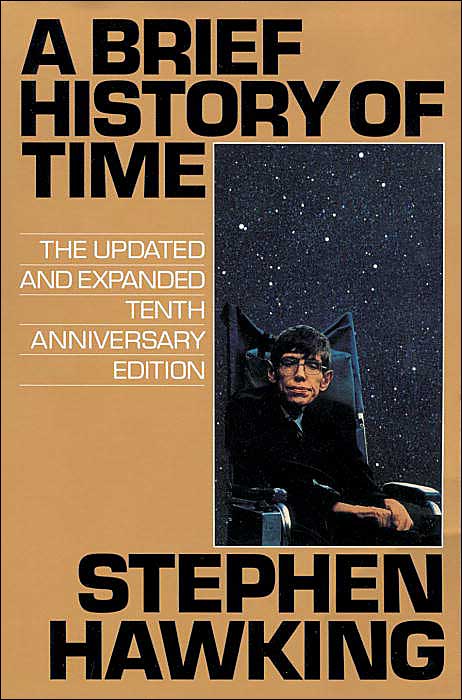 The following is from a recent Books & Culture article on the famous physicist, Stephen Hawking. The article as a whole seeks to introduce people to the man while commenting on his understanding of God and religion. I recommend the article, particularly if you want a brief overview of his bestseller, A Brief History of Time. At the end of the article, though, author Karl Giberson comments on Hawking’s “theology.”
The main critiques are that Hawking has no understanding of Christian theology, and that if he did, he wouldn’t confuse science and theology the way that he does. The Christian doctrine of creation is not in competition with the scientific explanation for the origin of the cosmos. The fact that Hawking gets this wrong only reinforces the mistaken views of the creationists. The difference is that Hawking is simply naive, while the creationists are intentional about equating science and theology. All of this just makes it harder for intelligent Christians to articulate the truth of the doctrine of creation. Here is what Giberson writes:
[Stephen] Hawking's theological naïveté is almost funny. He appears not to know that the heart of the Judeo-Christian doctrine of creation is that the world derives its being from God, not that God "started" the world, like some kid building a model airplane. Everyone from Augustine and Aquinas to Barth and Pannenberg has addressed this important distinction. The suggestion that a physical theory ruling out a well-defined "beginning" to the universe removes God from creation is the sort of simplistic misunderstanding that might be tolerated in philosophy students' first term papers, but certainly not their second.
And what of Hawking's claim that knowledge of the profoundly misnamed "Theory of Everything" would be like entering into the mind of God? Really? Is this what God thinks about? What God is this? Is there actually a church somewhere that puts equations on a big screen and invites worshippers to view them as a prelude to worship? Is this the same God whose existence Hawking disproved a few pages earlier?
All this would indeed be humorous if it were not in a book that has sold ten million copies. Hawking has done a great disservice to those purchasers of his book who have actually read it. He has misled them about the religious implications of science and the apparent motivations of scientists; he has made bogus claims about theology; he has juxtaposed science and theology as if they compete to explain the same things. Hawking's enthusiasm about doing away with God does not reflect the views of the scientific community, where there is widespread belief in God, and widespread disinterest in using science against religion.
Hawking is a major public intellectual, a leading scientist with a flair for popular exposition and a platform from which to explain science to an educated populace. He and his scientific allies—Richard Dawkins, Edward O. Wilson, Peter Atkins, the late Stephen Jay Gould, Steven Weinberg, Stephen Pinker and so on—shape public perceptions of science through their popular presentations, in books, articles, and public appearances. Their collective message—drilled home in many different ways—is that science is hostile to religion, scientists don't believe in God, and science competes with religion to explain natural phenomena.
None of these statements is true.
Rabu, 05 September 2007
Lesslie Newbigin: creation as an act of divine peace
 “The first chapter of Genesis was almost certainly written during the time when Israel was in exile in Babylon. And we must picture these writers as slaves under the shadow of this mighty empire with its palaces, fortresses and temples. Babylon had its own account of creation, as we know from the work of modern scholarship. It was a story of conflict, battle and bloodshed. Violence was the theme underlying the whole creation story as the Babylonians understood it.
The writers of Genesis had a quite different picture of God. They were the descendants of Abraham, Isaac, Jacob and Moses. They knew God as the redeemer God, the God who had saved his people from bondage. And they had a totally different picture of God’s creation—not as the result of violence but as the action of a God of love and wisdom who, out of sheer love, desired to create a world to reflect his glory and a human family to enjoy his world and give back his love.
And so we have in Genesis a picture of the creation of light to be distinguished from darkness, of the dry land to be distinguished from the chaos of the sea, of a home in which living creatures could grow and thrive, of the creation of the animals and of human beings among them, and of the special responsibility given to human beings of being in the image of God. And to this human family he has given the specific responsibility of cherishing his creation, of bringing it to that perfection for which God intended it, so that it, with the whole human race, should truly reflect his glory.”
—Lesslie Newbigin, A Walk Through the Bible (Vancouver, BC: Regent College Publishing, 1999), 6-8.
Rabu, 08 Agustus 2007
Barth: the State belongs to the order of redemption
“The State belongs to the order of redemption. It is no accident that the place where the State appears in the Creed is in the second article (‘suffered under Pontius Pilate’) and not in the first article. It is pertinent to add that if we understand the State as an institution of the wisdom and patience of God and do not split up the work of God into various departments but see it as an undivided whole, we shall see the State strictly related to the mercy of God. It is God’s intention to see that His mercy may have scope to unfold on earth. This is in fact the purpose of creation in general, to provide a theatrum gloriae suae (Calvin). In the sphere of nature there is intended to be an order of the grace of God, and this space is guaranteed by the State. If our interpretation of the relationship between the State and the heavenly powers and forces, as expounded in the New Testament, is correct, we shall know that these powers are not almighty but subject to Christ, so that even in the State we are fundamentally in the regnum Christi, which has its centre, however, in the Church. It is also no accident that there is a linguistic affinity between the inner and the outer circle. Christ is called the Messiah, the King of Israel, who has brought in the Kingdom, the basileia. And the polis is the expectation of Christians; they themselves are called citizens and dwellers in the same house together—all these are primarily political concepts which are naturally used metaphorically in the Church, but they do show that the political sphere is related to the ecclesiastical. We have to interpret creation from the standpoint of redemption and not the other way round.”
—Karl Barth, “From the Discussion in Budapest on the Morning of April 1st 1948,” Against the Stream: Shorter Post-War Writings 1946-52 (London: SCM Press, 1954), 94-95.
—Karl Barth, “From the Discussion in Budapest on the Morning of April 1st 1948,” Against the Stream: Shorter Post-War Writings 1946-52 (London: SCM Press, 1954), 94-95.
Jumat, 03 Agustus 2007
Barth: the church must be political
“The Christian Church knows only one Lord, His system, His law, His power. But it knows this Lord as the Lord of all lords. It therefore sees His order, His will, His institution and His hand in political systems, with all their provisional and limited aims. It realises that political systems are run by men. But it sees a divine commission above and behind this provisional and limited work of man. It sees a necessary and wholesome gift of God in this work of man. What is at issue is the preservation of the common life from chaos. Political systems create and preserve a space for that which must happen in the time between the beginning and the end of which we have spoken: a space for the fulfilment of the purpose of world history, a space for faith, repentance and knowledge. They create a space for the life and mission of the Christian Church and therefore a space for something the whole world needs. … The Church knows all the more what political systems are for. Political systems may be as unecclesiastical as they like, but the Church cannot on any account be unpolitical, and that applies to all its members too.”
—Karl Barth, Against the Stream: Shorter Post-War Writings 1946-52 (London: SCM Press, 1954), 80-81
—Karl Barth, Against the Stream: Shorter Post-War Writings 1946-52 (London: SCM Press, 1954), 80-81
Sabtu, 30 Juni 2007
The Spirit of the Lord, §10.3: Political Pacifism
 Third, the vision of the New Jerusalem is politically pacifist. The term “politically pacifist” combines two ideas—political and pacifist. Each one is worthy of discussion in its own right, but in the passage from Micah, the two terms cannot be dissociated. The passage is political precisely in that it is a vision of peace. Peace is portrayed in fundamentally political terms—“nation shall not lift up sword against nation”—so that it becomes impossible to discuss the political nature of Micah’s vision without also discussing its radical vision of peace and justice. To place a wedge between the two ideas would be to distort the text. Peace throughout Scripture is a sociopolitical reality which has dramatic ramifications for everyday human life. No aspect of our creaturely existence is untouched by the reign of peace.
That said, Micah boldly proclaims a politically charged vision of a community of peace (communio pacis). The eschatological New Jerusalem will not be an inner kingdom of the soul but a sociopolitical kingdom of reconciliation in which the many nations “shall beat their swords into plowshares, and their spears into pruning hooks” (Mic. 4:3). Micah presents the vision of a new world in which the bellicose become pastoral, in which weapons become agricultural instruments, and in which Armageddon becomes Arcadia. It is a vision of the impossible possibility that war shall be no more, that nation shall not lift up sword against nation, that no one shall learn the way of violence (via violentiae) any longer but instead learn the way of peace (via pacis). It is a vision which fundamentally alters the horizon of reality, which subverts the actual in favor of the possible, which transforms the very contours of a creation enslaved to violence, a creation in bondage to being incurvatus in se. It is a vision anticipating the fulfillment of Jesus’ prayer: “your kingdom come; your will be done, on earth as it is in heaven” (Matt. 6:10; Lk. 11:2b). To paraphrase Gal. 6:15, according to Micah’s prophecy, neither war-making nor agriculture is anything; what matters is a new creation.
In the statements above, I should really say that the creation is only seemingly in bondage, because the event of Jesus Christ is the true cosmic reality which definitely liberated creation from its enslavement through his death and resurrection. At the eschaton, the bondage of creation will be revealed as the nothingness that it actually is, and God will be “all in all.” However, here and now, such bondage to sin and death is a palpable reality which enshrouds our lives in shadow, even though we know the Light has already come in Jesus Christ. For now, however, we await the day of the Lord when this Light will shine in fullness of glory, when every knee shall bow and every tongue confess that Jesus Christ is Lord, to the glory of God the Father (Phil. 2:10-11).
The reign of God is a reign of peace. The messianic prophecies proclaim peace as the mark of Christ’s reign. Isaiah not only declares that the messiah, the promised child, is the Prince of Peace, but just prior to this announcement the prophet proclaims: “For all the boots of the tramping warriors and all the garments rolled in blood shall be burned as fuel for the fire” (Isa. 9:5). The righteous reign of the messianic king will result in the annihilation of all instruments of warfare. As a result of his reign, “there shall be endless peace” (Isa. 9:7); in the presence of Christ, the very possibility of one nation rising up against another will be definitively destroyed. The Deus pacis declares a clear No to any human attempt to say No to a fellow human; God’s definitive No renders the No of one human against another utterly obsolete. God’s No is also for all the nations. The messiah not only demilitarizes the enemies of Israel; rather, all people are stripped of their weapons. No one is exempt from the divine judgment against violence.
He will cut off the chariot from EphraimGod’s No is, of course, entirely in service to God’s Yes. The judgment against violence and warfare serves the establishment of human solidarity in peace. God denies the use of swords and battle bows—not to mention the use of machine guns, ballistic missiles, and the latest Future Force Warrior systems—in order that humans might serve their neighbors instead of subjugate them and love their neighbors instead of ignore them. God says No to the oppressive domination of nation against nation and neighbor against neighbor, and Yes to the universal liberating domination of the messiah who “shall command peace to the nations” and whose “dominion shall be from sea to sea.” God says No to human enslavement to the powers of death and Yes to human liberation for life in correspondence to the Word. God says No to homo incurvatus in se and Yes to homo extra se: No to humanity curved in upon itself and Yes to humanity outside itself. Humanity curved in upon itself is a humanity content with denying life and love to others; only humanity outside itself is capable of serving the other as Christ served us by taking the form of a servant and submitting to a violent death on a cross for the sake of a world lost in a maelstrom of violence.
and the war horse from Jerusalem;
and the battle bow shall be cut off,
and he shall command peace to the nations;
his dominion shall be from sea to sea,
and from the River to the ends of the earth. (Zech. 9:10)
The heart of the pacifist vision of the prophets is the covenant of grace. The prophet Zechariah follows the proclamation of God’s righteous and peaceful reign “from sea to sea” with the important declaration: “As for you also, because of the blood of my covenant with you, I will set your prisoners free from the waterless pit. Return to your stronghold, O prisoners of hope; today I declare that I will restore to you double” (Zech. 9:11-12). The Lord liberates on the basis of the covenant. The deliverance of the captives which we find in Isa. 61 is here rooted in the covenantal relation between God and the people of God. As a result of the covenant of grace established and maintained by the Lord, those who are presently imprisoned are paradoxically called “prisoners of hope.” A true “theology of hope” thus depends on a robust theology of the covenant: eschatological hope is covenantal hope, eschatological peace is covenantal peace.
The path of peace remains an impossibility. We cannot forget this. We cannot forget that no amount of ethical striving and political manipulation will make such peace a human possibility. There is no way from ‘here’ to ‘there,’ so to speak. But because it is the Lord alone who judges between nations, such peace is indeed an impossible possibility. Micah is quite clear: the Lord God “shall judge between many peoples, and shall arbitrate between strong nations far away” (Mic. 4:3). Micah’s vision is no social program or political platform that only awaits the human will to implement it. On the contrary, it is an eschatological vision, which is to say, it is a vision of divine possibilities. Micah speaks not of what humanity can accomplish through its own resources, but rather of what God alone can accomplish as the Judge and Arbiter between peoples. God alone is the source, preserver, and finisher of peace. The God who liberated Israel from bondage is the Deus pacis, and only as the community shaped by God’s covenant of grace can humanity flourish as the communio pacis. Only because we are judged by the Lord is true justice possible. Only because we are liberated by the Lord is true freedom possible. Only in light of the reconciliation accomplished by the Lord is there a message of reconciliation for all peoples and life everlasting in the eternal kingdom of Christ.
The epistle of Jude makes a striking connection between Israel’s liberation from Egyptian oppression and the person of Jesus Christ. In Jd. 5, the author writes: “Now I desire to remind you, though you are fully informed, that the Lord, who once for all saved a people out of the land of Egypt, afterward destroyed those who did not believe.” Here Jude explicitly says that the Lord is the one who delivered Israel from the hands of Pharaoh. That “Lord” refers specifically to Jesus Christ is made clear in the previous verse, in which Jude denounces the false teachers (“intruders”) who have “stolen in among you . . . and deny our only Master and Lord, Jesus Christ” (v. 4). (Not to mention the fact that a number of ancient authorities replace “Lord” with “Jesus” in v. 5.) In these two verses we thus have a brief glimpse of an early christology, which confesses Jesus Christ himself as the one who freed Israel from slavery. Like Paul, Jude affirms Christ’s preexistence, but whereas Paul speaks of Christ’s activity primarily in terms of election (Eph. 1:4-5) and creation (Col. 1:15-16), Jude goes a step further and establishes Christ’s involvement in the events narrated in the Old Testament. Christ is not only involved in pre-temporal eternity or in the origins of creation; he is also the active agent throughout salvation history. Jesus Christ, the one who definitively liberated humanity in his death and resurrection, is also the one who liberated Israel as a proleptic realization of what he would later accomplish on the cross. On the basis of this christological insight, we can supplement the exclusionist reading of the exodus put forward by Jude with a more christocentric account of divine reconciliation. While Jude is correct to point out that Christ is the one who liberates—in the past events of exodus and crucifixion, in the present event of the word proclaimed, and in the future events of redemption and glorification—we must remember that Christ’s saving work encompasses even those who were “destroyed” in the event of Israel’s deliverance. Jude denounces the “intruders” as the “ungodly” (vv. 4, 15), but we must confess along with Paul that “while we were still weak, at the right time Christ died for the ungodly” (Rom. 5:6).
Langganan:
Postingan (Atom)