Tampilkan postingan dengan label RIP. Tampilkan semua postingan

Rabu, 16 Desember 2009

Considering Oral Roberts

Ted Olsen has an article in today’s Christianity Today which seeks to correct the obituaries regarding Oral Roberts and his connection with the so-called “Prosperity Gospel.” He cites Mark Silk and The New York Times as bad examples, and then writes the following:
But Silk and the Times may be confusing Roberts and another Tulsa resident, Kenneth Hagin, who is far more widely recognized as the man who joined Pentecostalism with the Faith Movement (also called "Word-Faith," or derogatively, the Prosperity Gospel or "Health and Wealth" gospel). Many scholars would credit Baptist E. W. Kenyon as the father of the teaching, and many other names would be more closely associated with it than Roberts (Kenneth Copeland, for example). The Dictionary of Christianity in America explicitly states that Roberts is "not fully identified with the movement [but] has close doctrinal and personal ties with many faith teachers." And in fact one of the first major critics of the Word-Faith movement was an Oral Roberts University theology professor, Charles Farah. (ORU's Howard Ervin was another vocal critic.)

Olsen is certainly right to complicate the overly simplistic connection between Roberts and the Word-Faith movement that prevails in mainstream media. And yet, a closer look at Olsen’s article complicates his thesis. Olsen himself goes on to complicate matters, and by the end, one is left wondering how exactly we should view Roberts vis-à-vis the Prosperity Gospel. This post is an attempt to clarify these matters. I should mention up front that I am not associated with Pentecostalism in any way, nor do I have any real knowledge of Roberts and his writings. I am simply offering some reflections on Olsen’s article.

To begin, we must note that Olsen only cites two obituaries. That hardly warrants the bold title: “Why the Oral Roberts Obituaries Are Wrong.” Maybe there are other obits which make this connection in an overly simplistic way; I don’t know. But based on the headline alone one gets the impression that everyone has misunderstood Roberts, and Olsen is here to set the world straight.

Second, Olsen’s article goes on to show that Roberts had a complicated relationship with the Word-Faith camp. While there is no direct causal relationship, there is certainly affinity. Citing David Edwin Harrell, Olsen writes that “Oral's beliefs ‘were not far from those of the moderate faith teachers,’ but argues that his identification with them was more in ‘a return to his cultural roots’ and had little to do with theology.” In pursuing mainstream respectability and legitimation, he later moved away from his Pentecostal roots and affiliated himself with the United Methodist Church. Later in life, however, he returned to Pentecostalism—and in full force. In the 1980s and beyond, Roberts was often indistinguishable from the Word-Faith televangelists, as his infamous “emotional blackmailing” in 1987 attests. (Olsen says that tying Roberts to the televangelism scandals is “somewhat inaccurate,” but isn’t this just another way of saying that Roberts is indirectly rather than directly connected to them?) This is where Olsen’s narrative begins to unravel. Essentially, he wants to make the last 30 years of Roberts’s life irrelevant for evaluating his legacy. Maybe there’s some basis for that, but any life-narrative which all-too-conveniently excludes the last third of a person’s existence is deeply suspect.

Third, and most importantly, Olsen fails to interrogate the theological relationship between Roberts and the Prosperity Gospel. While Harrell differentiates between their theologies, we need to look more carefully at this. I’ll admit again that I have not read Roberts’s theology, so I’ll stick to what I do know: that Roberts advocated the position that faith can and often does bring miraculous healing of the body, and that we should expect such healings within the church. While it may be true that Roberts did not personally preach that faith can also lead to monetary “healing,” are we supposed to buy in to the claim that the two are unrelated? Even if one does not necessarily lead to the other, can there be any doubt that the faith-healing position of Roberts opened the door to the Prosperity Gospel and made such a position viable within modern Pentecostalism?

A further historical point is worth making: both Roberts and the Word-Faith movement are modern derivations of the “new measures” movement inaugurated by Charles Finney in the Second Great Awakening. For the best account of this, see Ted Smith’s remarkable book, The New Measures: A Theological History of Democratic Practice. Smith shows how Finney’s preaching was rooted in issues of respectability, novelty, individual autonomy, and cults of personality—all elements on full display in the life of Oral Roberts and the entire Word-Faith movement.

The deepest bond between them, however, is not historical or causal but rather theological. Both believe that the rewards of faith are to be experienced here and now within this present life. That is, both believe in a radically realized (or perhaps realizing) eschatology, and both believe that eschatological beatitude consists in temporal blessings and bodily perfection. To put it differently, both advocate a “theology of glory,” rather than a “theology of the cross.” Both seem to find their inspiration more in King Solomon than in Jesus of Nazareth.

At the end of the day, Olsen’s attempt to distance Roberts from the Prosperity Gospel feels forced. By contrast, the statement by the New York Times that Roberts was the “patriarch” of the Prosperity Gospel seems about right. He may not have directly brought the Word-Faith movement into existence, but he clearly laid the historical and theological foundation for its prosperity (no pun intended) within American Pentecostalism. And isn’t that what being a patriarch is all about?

Senin, 13 Oktober 2008

Aquila the Hamster (March, 2006 - October, 2008)


Our beloved little hamster, Aquila, has finally passed away. My wife and I first got him back in March of 2006. At the pet store, we held two different hamsters: one bit me right away, while the other one didn’t. Ever since then, he has been the nicest possible hamster—never biting, always playing with us, even responding to our calls. When we took him in to the veterinarian one day to check out a strange bump, he said that Aquila was the nicest hamster he had ever seen. And that’s been the story. For the last two and a half years, we have been blessed by our little furry friend, who has brought us so much joy.

Suddenly, in the last few weeks, he aged rapidly, becoming more lethargic and refusing to eat his food. Knowing that he was near his end, we took him out a couple last times and got some pictures. (The two pictures were taken last week.) We held him close and told him how much he meant to us. Tonight, finally, he died. He looked very peaceful. We buried him behind our apartment building and gave him a tearful eulogy. Thanks, Aquila. You brought us so many good memories.

Sabtu, 13 September 2008

Resquiescat in Pacem: David Foster Wallace (1962-2008)


I have nothing to say about this right now. This is the saddest news I have heard in years. Maybe at some later point I will be able to gather myself to write something meaningful. For now, I am mourning the loss of our generation’s greatest writer.

Selasa, 11 September 2007

Resquiescat in Pacem: Madeleine L’Engle (1919-2007)

Madeleine L’Engle, the author of the classic children’s book, A Wrinkle in Time, died last Thursday, September 6, of natural causes. L’Engle was a prolific author who composed fiction for both children and adults, nonfiction, and poetry. She has been recognized for her literary achievements many times over. In addition to the Newbery Award for A Wrinkle in Time, L’Engle has received the Sophia Award (1984), the Regina Medal (1985), the ALAN Award (1986), the Kerlan Award (1990), and the National Religious Book Award. Her death is a deeply sad event for her many devoted readers. One of her most devoted readers is my wife, Amy, who has read and owns almost every single book that L’Engle has published. Amy has made it her goal to collect all of her works, and she is only two or three away. For those of you who do not wish to collect her works for yourself, you may always visit the Wheaton College Special Collections, which has housed the Madeleine L’Engle Collection since 1976. In light of her death, the Wheaton College Special Collections has created a special online photo gallery.

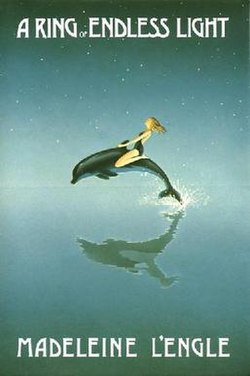
While her Time Quartet is the best known of all her books, L’Engle has many other works that are equally as good. One of the distinctive features of L’Engle’s fiction is her carefully constructed families which form the characters for most of her young adult fiction. The Time Quartet centers on the Murry-O’Keefe family, while the Austin family is the focus for a number of other books, including Meet the Austins, The Moon by Night, and my wife’s favorite book by L’Engle, A Ring of Endless Light. L’Engle identifies these two families as Kairos and Chronos, respectively. There is also a list of characters who bridge Kairos and Chronos, and thus weave in and out of the various books. In addition to her young adult fiction, L’Engle has written the autobiographical Crosswicks Journals, and the Genesis Trilogy, and numerous other works of fiction, nonfiction, and poetry. My wife’s favorite adult fiction work is A Live Coal in the Sea, which is one of two books centered on the character of Camilla Dickinson.

My favorite works by L’Engle are her books of nonfiction, particularly Penguins and Golden Calves, The Rock That Is Higher: Story as Truth, and Walking on Water: Personal Reflections. These books reward multiple readings. L’Engle’s wisdom and spiritual insight is on full display in these works, as she discusses art, literature, faith, Scripture, worship, and love in ways that are both deeply moving and profoundly theological. In her book on icons and idols, Penguins and Golden Calves, L’Engle coins a word that I have been using for several years now to describe the brand of evangelicalism which is both fundamentalist and literalist. She writes in response to some women who spread lies about her in the 1990s:
These women, like many of the attackers, call themselves fundamentalists, but that is not a good use of a perfectly good and useful word. I, too, am a fundamentalist, though the word is too often used pejoratively, to describe anybody who disagrees with a particular brand of Christianity. I believe the fundamentals of the faith. ... I do care about the fundamentals, which to me are the rock of love on which I stand, the Love that was great enough to create not only the magnificence of the starry sky but each one of us—the Love that will never let us go until we become what our Maker wants us to be.

So yes, I think of myself as a fundamentalist, that is, someone who still cares about fundamental things, like truth and friends and imagination and love and story and honour and compassion, none of which seem important to the fundamentalists, or literalists, or whatever word we currently use. ... [P]erhaps we need another word that is simpler than fundamentalist/literalist. A word like fundalit.
Throughout this wonderful little book, she reflects on our images of God (using Amma as well as Abba), the story of Scripture, and heaven and hell. Her other works are equally as illuminating. But I think the most appropriate way to remember L’Engle is through her poetry. She published a few works of poetry in her life, but her writing style is poetic through and through. And poems appear in most of her books at some point. Recently, her poems were collected in the book, The Ordering of Love. The following is a previously uncollected poem which, like most of her poems, focus upon the crucified and risen Christ.
“I am become like a pelican . . .”

I am become like a pelican in the wilderness....
For I have eaten ashes as it were bread,
and mingled my drink with weeping....
But thou, O LORD, shalt endure for ever.
—Psalm 102:6, 9, 12

God is dead? Well, of course God is dead!
Where have you been? Did you not see the dark
Cover the hill and strike against the cross?
We killed him then two thousand years ago
And once was not enough. We kill him now
In each denial, each unloving act.
Daily we kill him, trampling on his name,
Spitting on his word. And we are told,
And rightly, that he died between two thieves
And not two candles shining on an altar.
And yet there, too, perhaps most terribly,
He’s crucified each day by priest and those
Who take him, unaware of all the clouds
Of witnesses encompassing them in song
And prayer, who kneel there coldly unaware
Of those who suffer in the adjoining pew.
We do not understand his feast; we live
Again his crucifixion, but forget,
Each time we crucify him there again
Between those candles whose bright flame is lost
To darkened eyes, that when he died for us
After three days he rose, and still for us.
We kill him, but we cannot keep his light
From blazing forth in flame for every one
Who fouls his word and calls him dead and cries
In loneliness because his name is lost.

And yet, receiving now my heart’s true food
I feel his light rush coursing through my blood.
Nourished by his spilled wine and broken bread,
I know that my Redeemer is not dead.
Update: “Remembering Madeleine” at Semicolon Blog.

Senin, 30 Juli 2007

Resquiescat in Pacem: Ingmar Bergman (1918-2007)

Ingmar Bergman, the greatest living filmmaker—and my personal pick for the greatest filmmaker of all time—passed away in his sleep at his home in Fårö, Sweden at the age of 89. He is the director of such influential and highly acclaimed works as The Seventh Seal (1957), Wild Strawberries (1957), Fanny and Alexander (1982), and Scenes from a Marriage (1973). His last film was 2005’s Saraband, a follow-up to Scenes from a Marriage.

Bergman was a consummate artist. He is known as the “poet with a camera” for the way his films penetrated the depths of human existence through carefully crafted gems of artistic beauty. His films were stark in their exploration of human death, sexual tension, the existence of God, human evil, and family disorder. Some of his images are iconic, such as the scene of Jöns playing chess with Death.

Many of his films are existential in nature—i.e., they probe the depths of human existence. Like Andrei Tarkovsky, Bergman is less interested in conventional storytelling and more concerned instead with crafting visual poems that delve into the human psyche. More so than almost any other director, Bergman used film as a vehicle for exploring the abyss and the peaks of human experience. The most poignant example of Bergman’s existentialist aesthetic is his 1966 masterpiece, Persona. In this film, a nurse is put in charge of a psychologically unstable actress, but in the course of their interaction, the two personae become harder and harder to distinguish. This film is one of Bergman’s most experimental and avant garde, and it is considered a hallmark of cinematic surrealism.

Bergman’s existentialism makes him one of the most important filmmakers for theologians. Bergman himself grew up in a strict Lutheran household, but he later claimed to have lost his faith at the age of eight. Not surprisingly, nearly all of his films grapple with important issues of belief and unbelief. The Seventh Seal openly discusses the existence (or non-existence) of God in relation to the problem of evil raised by the reality of the bubonic plague. Fanny and Alexander, the most autobiographical of Bergman’s films, presents an unforgiving look at the clergy through the character of Bishop Edvard Vergerus, and young Alexander has a Wizard of Oz moment in which a teasing adult pretending to be God suddenly reveals that he was playing the whole time. (This scene is probably Bergman’s interpretation of his own loss of faith at the age of eight.)

For what it’s worth, Fanny and Alexander is my personal favorite of Bergman’s films. The film is a profound exploration of the power of the art, a beautiful portrait of a family, and a simple testament to the depth of Bergman’s own artistic vision. At the start of the movie, Oscar Ekdahl gives a speech to the theater troupe with which he has worked all his life. He says:
My dear friends, for 22 years, in the capacity of theater manager, I've stood here and made a speech without really having any talent for that sort of thing. Especially if you think of my father who was brilliant at speeches. My only talent, if you can call it that in my case, is that I love this little world inside the thick walls of this playhouse, and I'm fond of the people who work in this little world. Outside is the big world, and sometimes the little world succeeds in reflecting the big one so that we understand it better. Or perhaps, we give the people who come here a chance to forget for a while, for a few short moments, the harsh world outside. Our theater is a little room of orderliness, routine, care and love.
The theme of the “little world” of art and the “big world” outside is recapitulated at the close of the film in an even more profound speech by Gustav Adolf Ekdahl. Without discussing the significance of this theme itself, I wish to suggest that this speech illuminates precisely what I think Bergman’s legacy should be: that in his “little world” of cinema, Bergman succeeded “in reflecting the big one so that we understand it better.”