Psalm 146:1-10
Praise the LORD!
Praise the LORD, O my soul!
I will praise the LORD as long as I live;
I will sing praises to my God all my life long.
Do not put your trust in princes,
in mortals, in whom there is no help.
When their breath departs, they return to the earth;
on that very day their plans perish.
Happy are those whose help is the God of Jacob,
whose hope is in the LORD their God,
who made heaven and earth,
the sea, and all that is in them;
who keeps faith forever;
who executes justice for the oppressed;
who gives food to the hungry.
The LORD sets the prisoners free;
the LORD opens the eyes of the blind.
The LORD lifts up those who are bowed down;
the LORD loves the righteous.
The LORD watches over the strangers;
he upholds the orphan and the widow,
but the way of the wicked he brings to ruin.
The LORD will reign forever,
your God, O Zion, for all generations.
Praise the LORD!
Selasa, 17 Juni 2008
Do not put your trust in presidents
After the Envision ’08 conference—in which there was so much talk about transforming society and influencing Washington—it’s only appropriate I think that we read and reflect on Psalm 146.

Senin, 16 Juni 2008
2008 Karl Barth Blog Conference
The second annual 2008 Karl Barth Blog Conference has begun over at Der Evangelische Theologe. This conference will explore the theology of Barth through the eyes of Eberhard Jüngel’s masterpiece, God’s Being Is in Becoming. Jüngel is the most notable German interpreter of Barth and a remarkable theologian in his own right. This blog conference looks to be an exciting event.
Jon Mackenzie’s contribution is currently online and examines the role of philosophy and theology in Jüngel. Yours truly has an essay appearing later on Jüngel’s mediating role between Barth and Bultmann. Because of its length, the “director’s cut,” so to speak, will appear in Fire & Rose after the edited version is posted as part of the conference.
Jon Mackenzie’s contribution is currently online and examines the role of philosophy and theology in Jüngel. Yours truly has an essay appearing later on Jüngel’s mediating role between Barth and Bultmann. Because of its length, the “director’s cut,” so to speak, will appear in Fire & Rose after the edited version is posted as part of the conference.
Envision 08: Final Reflections
 Here in this final post, I want to reflect back on Envision 08 by looking at (1) the learning tracks, (2) what was missing from this conference, and (3) the conference’s historical significance.
1. The Learning Tracks
Perhaps the most innovative feature of Envision was the learning tracks. Instead of workshops or break-out sessions, each attendee chose a learning track to attend throughout the entire conference. The learning tracks met twice on Monday and twice on Tuesday, each time right after the plenary sessions. These groups then get to know each other in an intimate classroom-like environment. Scholars or activists in a particular field lead these groups. The goal is to foster critical and insightful dialogue that builds off of the plenaries, offers concrete applications, and anticipates future developments in the arena of Christianity and political engagement.
While the tracks themselves are a brilliant idea, the conference leaders are also to be commended for organizing a broad spectrum of learning tracks. The topics included consumerism (with Ron Sider), religious pluralism (with Miroslav Volf), evangelism (with Vincent Bacote), and the one I chose, on evangelicalism and empire (with Bruce Benson and Christian Collins-Winn). Some were quite creative and even groundbreaking: reconciliation in the Holy Land (Andy Saperstein), human trafficking as slavery (Kathy Maskell), and good news for the First Nations and Native American peoples (Terry LeBlanc). A couple other learning tracks were unnecessary, including one called “On-Ramps to the Highway of Christian Activism” and another on “shalom theology.” The former was too general to have any real purpose, and the latter was a rather annoying demonstration of the influence of Lisa Sharon Harper, who is one of Envision’s organizers. A “shalom theology” may be worthwhile, but certainly not at the expense of other issues that are more important (e.g., HIV/AIDS, post-colonial Africa, the emerging church, the church in the Global South, Christianity and Islam, etc.). Sadly, David Gushee’s learning track on “Peace in a World of Perpetual War” was cancelled for some reason. I had originally signed up for this track.
I heard some complaints about the lack of practical solutions to the problems that were presented, but overall people seemed to like how these groups were set up. My group, on evangelicals and empire, was a very good learning track, put together because of a volume titled Evangelicals and Empire, edited by Bruce Benson and Peter Heltzel. (I saw the proofs for the book at the conference, and it looks like a spectular volume.)
2. What Was Missing
 While no conference can address everything about a topic, there were certain issues regarding the gospel and politics that should have been addressed. Without question, the most important topic that received almost no discussion at all was that of war and peace, or militarism and pacifism. Certainly, people brought up their opposition to the war in Iraq and war in general, but there was no focused discussion of peace in the plenaries. After Gushee’s group was cancelled, the issue was absent from the learning tracks as well. This was a massive oversight in the conference. For starters, the issue of war and peace is perhaps the most basic and foundational topic in politics. Any dialogue about how the gospel and politics interrelate has to address Christianity’s relationship with violence. Moreover, since the conference focused so much attention on “shalom theology,” it is rather ironic that almost nothing was said about peace! Instead of Obery Hendricks and/or Lisa Sharon Harper, the organizers of the conference should have asked Glen Stassen to speak about the politics of Jesus. Or, if not Stassen, then Willard Swartley should have come to speak about the politics of the New Testament. Swartley has recently released a groundbreaking book on the NT witness to peace entitled, Covenant of Peace.
While Stassen is a Baptist, Swartley is a Mennonite, a group that did not receive a fair hearing at the conference. And this raises two issues: first, the question about which Christian groups were present and which were excluded, and second, the tension between Anabaptist and Constantinian ecclesiologies that I brought up in my reviews of the conference. Regarding the first issue, Envision was marked by the absence of Roman Catholic and Eastern Orthodox Christians, in addition to Anabaptist/Mennonite voices. The conference was a decidedly Protestant gathering—or, rather, a mainline and evangelical Protestant gathering—and that’s a huge limitation for a group trying to be ecumenical and multicultural. Christians from almost every ethnic/racial group were represented, but not Christians from the largest branches of the global church. Why not? The Catholic emphasis on social justice is arguably one of their great legacies in the 20th century. And the Quaker witness against slavery and war is perhaps second to none. The emphasis on American evangelicalism was good, but a bit one-sided, and most likely a reflection of who was organizing the conference.
Regarding the second issue, the lack of representation for Anabaptists resulted in an overall failure to address the question about whether Christians can and/or should serve in positions of power. All too often people spoke as if the state government is responsible for bringing about the kingdom of God, or at least as if Christians need to focus their energies on making the nation as Christian as possible. Anabaptists focus the attention on the church itself. Instead of making the nation Christian, they seek to make the church Christian. Envision 08, however, was so interested in exploring how to transform the world that it failed to acknowledge and address the views of Anabaptists who fundamentally reject this impulse. While I am glad space was given to people like Shane Claiborne alongside Rich Cizik, I am convinced that the church will not be able to move forward properly until we examine the relationship between Christianity and state/secular power.
Other topics were missing as well, besides that of war and peace. There was no discussion of “missional theology,” despite the fact that it addresses many of the issues of evangelism, culture, and the relation between the gospel and society. There was also no presentation on a theology of God’s reign or God’s kingdom, despite the fact that almost every single person talked at length about the kingdom of God. But what does this term mean? What does Scripture mean by the kingdom, and what is the kingdom’s relationship with the church? Is the church identifiable with God’s reign, and if not, then what is the role of the church in relation to this eschatological reign? While torture was mentioned by certain people in passing, the issue of human rights was also not addressed. In a future conference, I would like to see David Gushee give one of the plenaries with a panel of human rights advocates and scholars responding to his talk. On a final note, I really wanted to hear from Jay Bakker, leader of Revolution Church NYC, who was scheduled to be a panelist for Harper’s plenary. Apparently, he couldn’t make it for some reason, but I hope he will be there at the next Envision.
3. Envision’s Significance and Future
For all its flaws, Envision 08 was a significant event, and it marks an interesting moment in the history of evangelicals in the United States. We often hear from political pundits that evangelicals are starting to branch out beyond the Religious Right. This movement away from the traditional evangelical issues was embodied in this conference. We saw vanguard leaders within the RR (Rich Cizik and Rev. Harry Jackson, Jr.) speak on stage side-by-side with people like Randall Balmer, Brian McLaren, Shane Claiborne, and others. The significance of that is hard to overstate. Sure, the dialogue between these people was very limited, but the historical importance of the event remains. In the future, I expect there will only be more interaction between these parties, as the RR dies and evangelicals begin to think about their relation to politics in altogether new ways.
The next Envision will be held in 2010. I imagine we’ll see many of these same people back again. While I applaud the attempt to be as broad, ecumenical, and multicultural as possible, there is much more work to be done. I already mentioned groups that need to be represented in larger numbers. Here I want to mention something more important: how those of us not in these groups should speak so that we make such people feel welcome, rather than excluded. The leadership of Envision 08 was focused in a few areas: InterVarsity, New York Theological Seminary, and New York Faith and Justice. While I am glad these groups (and some others) partnered together to make the conference happen, at times it felt like the people on stage were speaking to themselves or to their own group of friends. The InterVarsity influence was especially strong: in addition to Harper, Jeannette Yep spoke about her experience with InterVarsity on the opening night and the worship band members came from the Urbana conference. But it’s not so much where people come from as how people speak. If the leaders of Envision really want the mainline people to feel welcome, they need to employ gender neutral language, especially when speaking about God. Throughout the conference, you could tell who was “evangelical” and who was “mainline” by whether or not they used a masculine pronoun in reference to God. Evangelicals certainly do not care if others do not use such language, but a number of mainline/liberal Christians will most definitely care about it. The evangelicals need to be more sensitive to this issue. Unfortunately, I don’t think it crossed any of their minds. We have an obligation to demonstrate hospitality to all groups, perhaps centrally through our language. I would like to see this issue addressed in the future.
Finally, I am very thankful for having attended this event. I am critical only because I want to see Envision be as fruitful as possible. There is much to gain from dialoging with others about how the gospel shapes our politics. Since this was the first conference of its kind, I expect only greater things the second time around. I eagerly look forward to 2010!
Sabtu, 14 Juni 2008
Envision 08: Summary and Review (Part 3 of 3)
In the first and second parts of this review, I covered the first two days of the conference, respectively. Here, in the final part, I evaluate the third day of the conference.
5. Plenary III: Obery Hendricks on the Politics of Jesus
 On Tuesday morning, Obery Hendricks presented us with the third plenary session. Like Balmer with Thy Kingdom Come, Hendricks gave us a presentation of his book, The Politics of Jesus. In this book (and in the lecture), he seeks to show that the Jesus of the NT is a political revolutionary. Hendricks did not have a well-organized presentation; his discussion of the issue was very repetitive and (at times) seemingly directionless. His basic thesis was that the Jesus of the NT demonstrates what he calls a “holistic spirituality,” in which the “vertical” and the “horizontal” go together—i.e., in which the worship of God and radical politics go hand-in-hand. The strong points in his presentation include a look at three Hebrew terms—I believe they were mishpat, tsedeq, and hesed—and an examination of the radical politics of the Lord’s Prayer (definitely the highlight of his talk). While I would certainly want to question the ease with which he and others at the conference arbitrarily bifurcate the “vertical” and the “horizontal,” as if one was separate and distinct from the other, I will give him the benefit of the doubt on this issue and focus on what I see to be the two major problems with his talk.
5.1. First, Hendricks repeatedly—not just a couple times but probably a dozen—denigrated theology and church tradition as obstacles in the way of encountering the “real” Jesus in the biblical text. In other words, he identified tradition and theology with a depoliticized Jesus. His own political Jesus can be plainly seen, according to Hendricks, once we discard doctrine and read the text with eyes freed from the past. Besides the self-serving arrogance of this sentiment (I alone know the real Jesus)—“chronological snobbery,” as C. S. Lewis put it—the idea that we must choose between the Christ of faith or the Jesus of the Bible is deeply problematic and, dare I say, anti-Christian.
Of course, Hendricks is not alone in dispensing with theology and doctrine. It was a theme that kept reappearing like a virus throughout the conference, most notably (or notoriously) in the Emerging Church roundtable discussion (see below). The fact of the matter is that people on all sides of the theological spectrum have reasons to denigrate theology. Those on the right do so whenever they want to replace a doctrine they do not like with their own individual interpretation of the biblical text. In such situations, people appeal to sola scriptura and talk about how exegesis always precedes theology, forgetting that all exegesis begins with certain theological presuppositions (even if they are only implicit). Those in the Emergent camp reject theology in favor of practice, hence the common notion that orthopraxis should replace orthodoxy (a patently false platitude which was heard repeatedly throughout the conference). But this again is only to replace one orthodoxy with another. Those on the left, like Hendricks, do so in order to substitute theology with a particular sociopolitical ideology.
What is common to all these positions is a remaking of Jesus in one’s own image. The political conservative makes Jesus into a capitalist warmongerer. The theological conservative makes Jesus into a preacher of penal substitution. The Emerging Church leader makes Jesus into a casual suburban moderate who is relevant to contemporary youth in the Western world. The liberal makes Jesus into an ancient Che Guevara—hence Hendricks’s use of violent imagery and his anti-Yoderian reading of the NT, despite the title of his book. More significantly, the Emergent and liberal views of Jesus end up endorsing a decidedly low christology. Both of them dispense with notions of atonement and soteriology and speak almost exclusively of Jesus as a model for ethical behavior. Hendricks, for his part, explicitly separated God from Jesus—a tactic common among liberals who reduce Jesus to the role of human prophet and want their abstract notion of “God” to be inclusive of, say, Allah. “God” becomes a cipher for whatever people think they worship, and Jesus becomes a model for how we should live socially and politically today. Jesus is a revolutionary, but not a savior.
Whenever one speaks against theology—either as something to be deferred until after exegesis or dispensed with altogether and replaced with some sociopolitical praxis—one must always interrogate the underlying agenda. Everyone has a theology, even atheists, insofar as atheism talks about God by rejecting God. Just as churches who claim to be creed-less or liturgy-less still have a creed and a liturgy, so too people who claim to discard doctrine still have doctrine. At the very least, their doctrine is that the dogmas of the past are irrelevant. Those who dispense with tradition are still part of a tradition: the tradition that dispenses with the past. Despite his claims to the contrary, Hendricks has a theology: his theology states that Jesus is not God incarnate but a human revolutionary who shows us how to live. Christology is reduced to an ethical anthropology, but it is still a theology.
The fundamental mistake that he makes is to identify doctrine with a depoliticized christology. He forgets that misuse does not bar proper use. Christian tradition may have misunderstood Christ and abused doctrine for the sake of ideological ends. But that does not preclude the possibility of understanding Jesus both as God in the flesh who accomplished the reconciliation of the world in his death and resurrection and as a sociopolitical radical. The two affirmations are not mutually exclusive. I can accept Hendricks’ political interpretation of Christ without dispensing with orthodox christology. Orthodoxy and orthopraxis support one another, and by grounding the latter in the former, I am not thereby becoming a tool of imperialist nutjobs or becoming a slave to the mistakes of the past (and there are certainly many mistakes). In the end, the agenda of Hendricks is all about clearing the ground of all past understandings of Jesus so that his alone remains as the “right” understanding.
5.2. His first mistake—denigrating theology and doctrine—then leads to his second and perhaps most shocking error: pitting (his version of) Jesus against (his version of) Paul. In the final section of his talk, Hendricks went from being annoying to being non compos mentis. He put forward the disturbing thesis that Paul did not understand Jesus, and that if we accept his view (and the right view) of Jesus, then we are obligated to reject Paul.
Why? Glad you asked. Hendricks, in an attempt to support his thesis, began by rattling off two already well-known facts: Paul does not talk about the historical life of Jesus, and Paul never quotes Jesus. Perhaps realizing that this was not enough, he then went on to assert that Paul was arrogant enough to think he could understand Christ on his own, and so Paul decided not to place himself under the tutelage of the Jerusalem church and went to Arabia instead. This decision, according to Hendricks, means that Paul gets the Christian faith all wrong. Paul doesn’t really know who Jesus is. In place of the radical politics of Jesus, Paul instead speaks theologically about justification, sin, salvation, reconciliation, etc. These are all concepts that are foreign to Jesus, and therefore alien to any true faith in Jesus. Hendricks tries to back this up by appealing to Romans 13 as an example of how Paul misunderstands the radically anti-imperial message of Jesus. The reading of this infamous chapter by Hendricks is nothing short of childish. It was really eye-opening to see him give such a nuanced and historically contextual reading of the Lord’s Prayer, but then decide to give a superficial, literal reading of Rom. 13. He was clearly trying to stack the deck against Paul in favor of Jesus, and thus against theology in favor of his own reading of the Bible. Chris Haw, the co-author with Shane Claiborne of Jesus for President, yelled out in the middle of Hendricks’s so-called exegesis, “Read Yoder! That’s a bad reading!” Others in the crowd murmured their agreement.
In the end, it is a short step from disparaging theology to disparaging Paul. If theology is an obstacle to a proper understanding of Jesus, then Paul—as the first Christian theologian—is also an obstacle. Here the arrogance has come full circle. It’s no longer just “chronological snobbery.” It is actually the arrogance of a person who places himself over against Scripture, over against the biblical canon. Ironically, Hendricks has made himself his own magisterium. He, and he alone, is qualified to interpret the Bible. But is this not precisely the kind of arrogance found in the history of the church which he sought to overcome by rejecting theology in the first place? Is this not to become that which one hates in the Other? Is this not, in the end, pure hypocrisy of the most self-righteous and theologically damaging kind—the kind that undermines the church in the name of Jesus? There might be plenty to gain from Hendricks, and I am sure his book has much to commend it, but it was not on display on Tuesday morning.
What is finally so sad about Hendricks’s presentation is that, in combatting a one-sided depoliticized reading of the NT, he himself gave a one-sided reading of the NT. Despite his best intentions, he ended up collapsing the “vertical” into the “horizontal,” to use his terminology. Rather than provide a broader understanding of Jesus that could reconcile various groups, he only reinforced the us-vs.-them narrative which conferences like Envision are specifically trying to subvert. And in rejecting doctrine, tradition, and the entire Pauline canon, he effectively placed himself against every evangelical who wishes to remain rooted in Scripture. Only at the end, after the panel discussion of his talk, did Hendricks offer the important caveat that he was only presenting one dimension of who Jesus is. But this kind of statement should not come after people respond to your work but before. If we are really going to make any progress in unifying the church and helping Christians to recognize their proper political witness, we need leaders who will seek to make friends, not enemies, and who will engage the full witness of Scripture and tradition, rather than cherrypick what they like and toss out what they don’t.
6. Plenary IV: Emerging Church and Post-Colonial Church Roundtable
The final plenary session had two parts: (1) a roundtable discussion on the Emerging Church with R.M. Keelan Downton, Al Hsu, Claude Nikondeha, Doug Pagitt, Gabriel Salguero, Michael Smitheram, Bowie Snodgrass, Alise Barrymore, and Randy Woodley; and (2) a roundtable discussion on the Post-Colonial Church with Ray Aldred, Ruth Padilla DeBorst, Brian McLaren, and Linda Thomas.
The Emerging Church roundtable was fascinating. They adopted the “Pecha Kucha” format for the presentation. With so many speakers, I cannot summarize everything that was said, but I will try to hit the highlights. After Keelan’s very helpful introduction, Al Shu began by talking about Christianity in suburbia and how the suburbs are often places of both physical and spiritual renewal. Bowie Snodgrass talked about her work with Transmission, an emerging liturgical community in New York City, which has sought recently to create a loving community for sex workers, most notably in the 2007 Easter service held at Club Avalon. Snodgrass also talked about her interfaith dialogues, even stating that she no longer believes that Christianity is the only way to salvation. Claude Nikondeha then spoke about his work with the Amahoro Africa project, which is an attempt “to encourage and facilitate a conversation and network of friendships among leaders engaging with the postcolonial African world in the name of Jesus.” The word “amahoro” means peace or wholeness; it is the Africa equivalent to shalom. Claude then introduced us to the word “ubuntu,” which he defined as: “I am who I am because you are who you are.” This was the most memorable and profound part of his presentation. The concept of ubuntu is significant not only because of its ethical and political implications, but also because of its theological import. Karl Barth defines humanity in his theological anthropology with the very similar statement that “I am as thou art.” In both statements, the human person is defined in relation to an other. Humans are essential social beings who exist in community. This is a profound insight, and I am grateful to Claude for making me aware of this African word.
 After Claude came Doug Pagitt, famous for being the founder of Solomon’s Porch. His presentation was the pomo version of what we heard earlier in the day from Obery Hendricks. His presentation ostensibly had two goals: (1) first, to reject the concepts, ecclesial models, and doctrines of the past, and (2) second, to affirm a Christainity that is redefined by our contemporary situation. In short, Pagitt’s position could be summarized as the pursuit for a “relevant Christian faith.” In the promotional video for his new book, he talks about how Christianity has to be reconceived so that it meets the needs of those living today. The Christianity of the past has nothing to say to us now; we need a new form of church. Pagitt has come out in the past and said that the creeds of the early church were just culturally bound statements about the faith as they saw it back then and thus need not be determinative for faith today. Creeds, like cathedrals, are basically relics of the past—museum pieces, not living testimonies to Jesus Christ. While I certainly agree with Pagitt that Christianity takes local, concrete forms, he and I differ radically in that I think such forms always have to be tested against the universal faith in Jesus Christ as attested in Holy Scripture. There is a kind of catholicity that grounds the particular embodiments of the ecclesial community. By rejecting anything catholic or universal in the Christian faith, Pagitt ends up making Christianity—and perhaps the gospel of Jesus Christ itself—in his or his community’s own image.
 Pagitt was followed by Randy Woodley, a Native American minister, theologian, and activist. He works with Eagle’s Wings Ministry, which is “a community of Native Americans and others, rooted in the Christian faith” that seeks to be “fully culturally Native American” while still proclaiming the gospel of Christ. He talked about the need for Christians to listen to some neglected voices of the faith, including Anabaptists (yes), Eastern Orthodox (yes), and Nestorians (what??). I think Woodley meant to imply the Assyrian Church of the East, who maintain a Nestorian christology but refuse the term “Nestorian,” both because of its pejorative connotations and the slight differences in their theology. But why stop there? Why not give the mono-/miaphysites in the Oriential Orthodox Church a similar hearing? The strange thing is that the Eastern, Assyrian, and Oriential Churches are all rooted in very ancient, metaphysical debates about the nature of Christ. Why are these still relevant to the church today, but not the churches of the Reformation? I submit that people like Woodley and Pagitt are primarily interested in rejecting the churches which are dominant in their own personal history. Their Emerging spirituality is more reactionary than it is theologically thoughtful.
Woodley closed his presentation by showing how Native Americans would want to replace traditional Christian terminology with a new, more culturally contextual language. He began by giving the traditional version:
While there is much to commend in Woodley’s ministry, he is nevertheless an example of the hegemonic rise of contextual theology, of which Pagitt is a part. I say this as one who is perfectly willing to embrace contextual and cultural hermeneutics and who has no interest in being rigidly bound to the tradition if the tradition is wrong. But at the same time I am confident that we have to subordinate contextual theology to biblical and systematic theology. Our contexts certainly shape how we engage Scripture, but they cannot dictate it. The revelation of God in Jesus Christ must always remain a disruptive word of grace which transcends while at the same time embracing our own particular contexts.
 After Woodley, Alise Barrymore gave the most polished and poetic presentation. She spoke to the issue of race and racial reconciliation in the Emerging Church. According to Barrymore, the previous generation fought for civil rights and racial justice in a way that was important and necessary. But their efforts were always on behalf of their own ethnic group. They fought for justice for themselves. Barrymore, by contrast, spoke about seeking justice for all people. She is the co-pastor of the Emmaus Community, which “is a non-denominational Christian community that is a unique fusion of post-modern worship and a celebration of the historic African American worship traditions.” Michael Smitheram spoke next about his involvement as the international coordinator for the Micah Challenge, which is “a global campaign to mobilise Christians against poverty.” Their goal is to cut world poverty in half by 2015. The name, of course, comes from Micah 6:8. They have leaders around the world advocating on behalf of the issue of poverty. The final speaker was Gabriel Salguero, who is pastor of the Lamb’s Church of the Nazarene, executive member of the Latino Leadership Circle, and director of the Hispanic/Latino Leadership Program at Princeton Seminary. He gave an excellent talk that brought together a strong evangelical faith with an emphasis on social justice and issues in the Latino community. Some of his powerful statements involved immigration. In a picture of Latinos desperately crossing some muddy water, he declared, “Behold your baptism!” It was a powerful statement.
After a short break, in which a young woman sang a song about humanity’s destruction of the earth, there was a second panel of scholars talking about the Post-Colonial Church. Here I will necessarily be very brief. The presentations were not nearly as memorable, in part because they did not have the beautiful slides to complement their talks. But the issue was very important. Brian McLaren made the important observation that if Emergent-types interested in postmodernism are not equally interested in postcolonialism, then they are only supporting the same colonial narrative which has wreaked so much havoc upon the world. It was an important statement, in part because it demonstrated McLaren’s own progression beyond his earlier infatuation with postmodernity. Ray Aldred and Ruth Padilla DeBorst both gave important messages about the post-colonial situation: Aldred in the context of Native American history, and DeBorst in the context of Latin American history. But it was McLaren’s discussion of his own family history that made the most impact, in part because it was so personal. I cannot tell the whole story here, but suffice it to say that his grandfather was a missionary in Africa whose property was used as a place where Africans who had not paid their taxes were beaten and perhaps killed by the colonial powers. His uncle had looked on in horror and pleaded with his father to do something. McLaren said that Christians in the West today need to stand with his uncle and seek to remedy the injustices of the past.
7. Closing Eucharist Celebration: Jim Wallis and John Perkins
 The day closed with a long worship service in which John Perkins was honored with an award for his decades of service to the Christian community. The leaders of Envision 08 said that they have named the award in his honor and will give it to someone following in his footsteps at every future Envision conference. Perkins then gave an impassioned (though at times hard to understand) speech about evangelicals being involved in the issues of poverty and racial reconciliation. After Perkins, Jim Wallis spoke about his experience with evangelicalism and social justice. Unfortunately, I had to leave early, so I did not hear the end of Wallis’s talk nor was I able to partake of the Eucharist. The service was held in the Princeton University Chapel. In the middle of a heat wave and without air conditioning, the service was uncomfortably warm. Even so, it was a fitting close to a remarkable gathering of scholars, ministers, and activists. I look forward with anticipation to Envision 2010.
Tomorrow I will wrap up my summary and review with a note on the learning tracks and some final reflections.
5. Plenary III: Obery Hendricks on the Politics of Jesus
 On Tuesday morning, Obery Hendricks presented us with the third plenary session. Like Balmer with Thy Kingdom Come, Hendricks gave us a presentation of his book, The Politics of Jesus. In this book (and in the lecture), he seeks to show that the Jesus of the NT is a political revolutionary. Hendricks did not have a well-organized presentation; his discussion of the issue was very repetitive and (at times) seemingly directionless. His basic thesis was that the Jesus of the NT demonstrates what he calls a “holistic spirituality,” in which the “vertical” and the “horizontal” go together—i.e., in which the worship of God and radical politics go hand-in-hand. The strong points in his presentation include a look at three Hebrew terms—I believe they were mishpat, tsedeq, and hesed—and an examination of the radical politics of the Lord’s Prayer (definitely the highlight of his talk). While I would certainly want to question the ease with which he and others at the conference arbitrarily bifurcate the “vertical” and the “horizontal,” as if one was separate and distinct from the other, I will give him the benefit of the doubt on this issue and focus on what I see to be the two major problems with his talk.
5.1. First, Hendricks repeatedly—not just a couple times but probably a dozen—denigrated theology and church tradition as obstacles in the way of encountering the “real” Jesus in the biblical text. In other words, he identified tradition and theology with a depoliticized Jesus. His own political Jesus can be plainly seen, according to Hendricks, once we discard doctrine and read the text with eyes freed from the past. Besides the self-serving arrogance of this sentiment (I alone know the real Jesus)—“chronological snobbery,” as C. S. Lewis put it—the idea that we must choose between the Christ of faith or the Jesus of the Bible is deeply problematic and, dare I say, anti-Christian.
Of course, Hendricks is not alone in dispensing with theology and doctrine. It was a theme that kept reappearing like a virus throughout the conference, most notably (or notoriously) in the Emerging Church roundtable discussion (see below). The fact of the matter is that people on all sides of the theological spectrum have reasons to denigrate theology. Those on the right do so whenever they want to replace a doctrine they do not like with their own individual interpretation of the biblical text. In such situations, people appeal to sola scriptura and talk about how exegesis always precedes theology, forgetting that all exegesis begins with certain theological presuppositions (even if they are only implicit). Those in the Emergent camp reject theology in favor of practice, hence the common notion that orthopraxis should replace orthodoxy (a patently false platitude which was heard repeatedly throughout the conference). But this again is only to replace one orthodoxy with another. Those on the left, like Hendricks, do so in order to substitute theology with a particular sociopolitical ideology.
What is common to all these positions is a remaking of Jesus in one’s own image. The political conservative makes Jesus into a capitalist warmongerer. The theological conservative makes Jesus into a preacher of penal substitution. The Emerging Church leader makes Jesus into a casual suburban moderate who is relevant to contemporary youth in the Western world. The liberal makes Jesus into an ancient Che Guevara—hence Hendricks’s use of violent imagery and his anti-Yoderian reading of the NT, despite the title of his book. More significantly, the Emergent and liberal views of Jesus end up endorsing a decidedly low christology. Both of them dispense with notions of atonement and soteriology and speak almost exclusively of Jesus as a model for ethical behavior. Hendricks, for his part, explicitly separated God from Jesus—a tactic common among liberals who reduce Jesus to the role of human prophet and want their abstract notion of “God” to be inclusive of, say, Allah. “God” becomes a cipher for whatever people think they worship, and Jesus becomes a model for how we should live socially and politically today. Jesus is a revolutionary, but not a savior.
Whenever one speaks against theology—either as something to be deferred until after exegesis or dispensed with altogether and replaced with some sociopolitical praxis—one must always interrogate the underlying agenda. Everyone has a theology, even atheists, insofar as atheism talks about God by rejecting God. Just as churches who claim to be creed-less or liturgy-less still have a creed and a liturgy, so too people who claim to discard doctrine still have doctrine. At the very least, their doctrine is that the dogmas of the past are irrelevant. Those who dispense with tradition are still part of a tradition: the tradition that dispenses with the past. Despite his claims to the contrary, Hendricks has a theology: his theology states that Jesus is not God incarnate but a human revolutionary who shows us how to live. Christology is reduced to an ethical anthropology, but it is still a theology.
The fundamental mistake that he makes is to identify doctrine with a depoliticized christology. He forgets that misuse does not bar proper use. Christian tradition may have misunderstood Christ and abused doctrine for the sake of ideological ends. But that does not preclude the possibility of understanding Jesus both as God in the flesh who accomplished the reconciliation of the world in his death and resurrection and as a sociopolitical radical. The two affirmations are not mutually exclusive. I can accept Hendricks’ political interpretation of Christ without dispensing with orthodox christology. Orthodoxy and orthopraxis support one another, and by grounding the latter in the former, I am not thereby becoming a tool of imperialist nutjobs or becoming a slave to the mistakes of the past (and there are certainly many mistakes). In the end, the agenda of Hendricks is all about clearing the ground of all past understandings of Jesus so that his alone remains as the “right” understanding.
5.2. His first mistake—denigrating theology and doctrine—then leads to his second and perhaps most shocking error: pitting (his version of) Jesus against (his version of) Paul. In the final section of his talk, Hendricks went from being annoying to being non compos mentis. He put forward the disturbing thesis that Paul did not understand Jesus, and that if we accept his view (and the right view) of Jesus, then we are obligated to reject Paul.
Why? Glad you asked. Hendricks, in an attempt to support his thesis, began by rattling off two already well-known facts: Paul does not talk about the historical life of Jesus, and Paul never quotes Jesus. Perhaps realizing that this was not enough, he then went on to assert that Paul was arrogant enough to think he could understand Christ on his own, and so Paul decided not to place himself under the tutelage of the Jerusalem church and went to Arabia instead. This decision, according to Hendricks, means that Paul gets the Christian faith all wrong. Paul doesn’t really know who Jesus is. In place of the radical politics of Jesus, Paul instead speaks theologically about justification, sin, salvation, reconciliation, etc. These are all concepts that are foreign to Jesus, and therefore alien to any true faith in Jesus. Hendricks tries to back this up by appealing to Romans 13 as an example of how Paul misunderstands the radically anti-imperial message of Jesus. The reading of this infamous chapter by Hendricks is nothing short of childish. It was really eye-opening to see him give such a nuanced and historically contextual reading of the Lord’s Prayer, but then decide to give a superficial, literal reading of Rom. 13. He was clearly trying to stack the deck against Paul in favor of Jesus, and thus against theology in favor of his own reading of the Bible. Chris Haw, the co-author with Shane Claiborne of Jesus for President, yelled out in the middle of Hendricks’s so-called exegesis, “Read Yoder! That’s a bad reading!” Others in the crowd murmured their agreement.
In the end, it is a short step from disparaging theology to disparaging Paul. If theology is an obstacle to a proper understanding of Jesus, then Paul—as the first Christian theologian—is also an obstacle. Here the arrogance has come full circle. It’s no longer just “chronological snobbery.” It is actually the arrogance of a person who places himself over against Scripture, over against the biblical canon. Ironically, Hendricks has made himself his own magisterium. He, and he alone, is qualified to interpret the Bible. But is this not precisely the kind of arrogance found in the history of the church which he sought to overcome by rejecting theology in the first place? Is this not to become that which one hates in the Other? Is this not, in the end, pure hypocrisy of the most self-righteous and theologically damaging kind—the kind that undermines the church in the name of Jesus? There might be plenty to gain from Hendricks, and I am sure his book has much to commend it, but it was not on display on Tuesday morning.
What is finally so sad about Hendricks’s presentation is that, in combatting a one-sided depoliticized reading of the NT, he himself gave a one-sided reading of the NT. Despite his best intentions, he ended up collapsing the “vertical” into the “horizontal,” to use his terminology. Rather than provide a broader understanding of Jesus that could reconcile various groups, he only reinforced the us-vs.-them narrative which conferences like Envision are specifically trying to subvert. And in rejecting doctrine, tradition, and the entire Pauline canon, he effectively placed himself against every evangelical who wishes to remain rooted in Scripture. Only at the end, after the panel discussion of his talk, did Hendricks offer the important caveat that he was only presenting one dimension of who Jesus is. But this kind of statement should not come after people respond to your work but before. If we are really going to make any progress in unifying the church and helping Christians to recognize their proper political witness, we need leaders who will seek to make friends, not enemies, and who will engage the full witness of Scripture and tradition, rather than cherrypick what they like and toss out what they don’t.
6. Plenary IV: Emerging Church and Post-Colonial Church Roundtable
The final plenary session had two parts: (1) a roundtable discussion on the Emerging Church with R.M. Keelan Downton, Al Hsu, Claude Nikondeha, Doug Pagitt, Gabriel Salguero, Michael Smitheram, Bowie Snodgrass, Alise Barrymore, and Randy Woodley; and (2) a roundtable discussion on the Post-Colonial Church with Ray Aldred, Ruth Padilla DeBorst, Brian McLaren, and Linda Thomas.
The Emerging Church roundtable was fascinating. They adopted the “Pecha Kucha” format for the presentation. With so many speakers, I cannot summarize everything that was said, but I will try to hit the highlights. After Keelan’s very helpful introduction, Al Shu began by talking about Christianity in suburbia and how the suburbs are often places of both physical and spiritual renewal. Bowie Snodgrass talked about her work with Transmission, an emerging liturgical community in New York City, which has sought recently to create a loving community for sex workers, most notably in the 2007 Easter service held at Club Avalon. Snodgrass also talked about her interfaith dialogues, even stating that she no longer believes that Christianity is the only way to salvation. Claude Nikondeha then spoke about his work with the Amahoro Africa project, which is an attempt “to encourage and facilitate a conversation and network of friendships among leaders engaging with the postcolonial African world in the name of Jesus.” The word “amahoro” means peace or wholeness; it is the Africa equivalent to shalom. Claude then introduced us to the word “ubuntu,” which he defined as: “I am who I am because you are who you are.” This was the most memorable and profound part of his presentation. The concept of ubuntu is significant not only because of its ethical and political implications, but also because of its theological import. Karl Barth defines humanity in his theological anthropology with the very similar statement that “I am as thou art.” In both statements, the human person is defined in relation to an other. Humans are essential social beings who exist in community. This is a profound insight, and I am grateful to Claude for making me aware of this African word.
 After Claude came Doug Pagitt, famous for being the founder of Solomon’s Porch. His presentation was the pomo version of what we heard earlier in the day from Obery Hendricks. His presentation ostensibly had two goals: (1) first, to reject the concepts, ecclesial models, and doctrines of the past, and (2) second, to affirm a Christainity that is redefined by our contemporary situation. In short, Pagitt’s position could be summarized as the pursuit for a “relevant Christian faith.” In the promotional video for his new book, he talks about how Christianity has to be reconceived so that it meets the needs of those living today. The Christianity of the past has nothing to say to us now; we need a new form of church. Pagitt has come out in the past and said that the creeds of the early church were just culturally bound statements about the faith as they saw it back then and thus need not be determinative for faith today. Creeds, like cathedrals, are basically relics of the past—museum pieces, not living testimonies to Jesus Christ. While I certainly agree with Pagitt that Christianity takes local, concrete forms, he and I differ radically in that I think such forms always have to be tested against the universal faith in Jesus Christ as attested in Holy Scripture. There is a kind of catholicity that grounds the particular embodiments of the ecclesial community. By rejecting anything catholic or universal in the Christian faith, Pagitt ends up making Christianity—and perhaps the gospel of Jesus Christ itself—in his or his community’s own image.
 Pagitt was followed by Randy Woodley, a Native American minister, theologian, and activist. He works with Eagle’s Wings Ministry, which is “a community of Native Americans and others, rooted in the Christian faith” that seeks to be “fully culturally Native American” while still proclaiming the gospel of Christ. He talked about the need for Christians to listen to some neglected voices of the faith, including Anabaptists (yes), Eastern Orthodox (yes), and Nestorians (what??). I think Woodley meant to imply the Assyrian Church of the East, who maintain a Nestorian christology but refuse the term “Nestorian,” both because of its pejorative connotations and the slight differences in their theology. But why stop there? Why not give the mono-/miaphysites in the Oriential Orthodox Church a similar hearing? The strange thing is that the Eastern, Assyrian, and Oriential Churches are all rooted in very ancient, metaphysical debates about the nature of Christ. Why are these still relevant to the church today, but not the churches of the Reformation? I submit that people like Woodley and Pagitt are primarily interested in rejecting the churches which are dominant in their own personal history. Their Emerging spirituality is more reactionary than it is theologically thoughtful.
Woodley closed his presentation by showing how Native Americans would want to replace traditional Christian terminology with a new, more culturally contextual language. He began by giving the traditional version:
I believe in God because I am a Christian. I read my Bible and help build God's kingdom as a missionary, sharing the gospel of salvation with the heathen. I tell them to repent from their sins and to be born again because of God's great love for them.And then he gave his modified version:
I believe in the Great Mystery because I am a follower of Jesus. I read the scriptures and help build the community of the Creator as an ambassador, sharing the good news of healing to the unversed. I tell them they can turn around from failing and to follow Jesus because of Creator's great love for them.While I want to affirm the need to rethink our language and categories, there is some serious theological revision going on here. It is not merely a formal change; the content is being altered as well. Some of the more benign changes like “ambassador” instead of “missionary,” or “Creator” instead of “God,” are mostly innocuous (though why not “Reconciler” or “Redeemer” instead of “Creator”?). Some are a bit annoying: “gospel” and “good news” mean the same thing, as do “repent” and “turn around.” There it’s only a matter of connotation, in which case we simply need to reeducate and use such words properly (again: misuse does not bar proper use). But two changes are unacceptable: replacing “salvation” with “healing” and “sin” with “failing.” Theologically speaking, this is to embrace pelagianism and a moral exemplar theory of the atonement—something which was heard throughout the conference. I am perfectly comfortable with replacing “born again” with “following Jesus,” because I think our individual salvation is defined as mission in the way of Jesus. Our reconciliation with God—and thus our freedom from damnation—is the work of Jesus Christ on the cross and encompasses all people already. But reducing salvation and sin to moral-ethical categories is simply untenable.
While there is much to commend in Woodley’s ministry, he is nevertheless an example of the hegemonic rise of contextual theology, of which Pagitt is a part. I say this as one who is perfectly willing to embrace contextual and cultural hermeneutics and who has no interest in being rigidly bound to the tradition if the tradition is wrong. But at the same time I am confident that we have to subordinate contextual theology to biblical and systematic theology. Our contexts certainly shape how we engage Scripture, but they cannot dictate it. The revelation of God in Jesus Christ must always remain a disruptive word of grace which transcends while at the same time embracing our own particular contexts.
 After Woodley, Alise Barrymore gave the most polished and poetic presentation. She spoke to the issue of race and racial reconciliation in the Emerging Church. According to Barrymore, the previous generation fought for civil rights and racial justice in a way that was important and necessary. But their efforts were always on behalf of their own ethnic group. They fought for justice for themselves. Barrymore, by contrast, spoke about seeking justice for all people. She is the co-pastor of the Emmaus Community, which “is a non-denominational Christian community that is a unique fusion of post-modern worship and a celebration of the historic African American worship traditions.” Michael Smitheram spoke next about his involvement as the international coordinator for the Micah Challenge, which is “a global campaign to mobilise Christians against poverty.” Their goal is to cut world poverty in half by 2015. The name, of course, comes from Micah 6:8. They have leaders around the world advocating on behalf of the issue of poverty. The final speaker was Gabriel Salguero, who is pastor of the Lamb’s Church of the Nazarene, executive member of the Latino Leadership Circle, and director of the Hispanic/Latino Leadership Program at Princeton Seminary. He gave an excellent talk that brought together a strong evangelical faith with an emphasis on social justice and issues in the Latino community. Some of his powerful statements involved immigration. In a picture of Latinos desperately crossing some muddy water, he declared, “Behold your baptism!” It was a powerful statement.
After a short break, in which a young woman sang a song about humanity’s destruction of the earth, there was a second panel of scholars talking about the Post-Colonial Church. Here I will necessarily be very brief. The presentations were not nearly as memorable, in part because they did not have the beautiful slides to complement their talks. But the issue was very important. Brian McLaren made the important observation that if Emergent-types interested in postmodernism are not equally interested in postcolonialism, then they are only supporting the same colonial narrative which has wreaked so much havoc upon the world. It was an important statement, in part because it demonstrated McLaren’s own progression beyond his earlier infatuation with postmodernity. Ray Aldred and Ruth Padilla DeBorst both gave important messages about the post-colonial situation: Aldred in the context of Native American history, and DeBorst in the context of Latin American history. But it was McLaren’s discussion of his own family history that made the most impact, in part because it was so personal. I cannot tell the whole story here, but suffice it to say that his grandfather was a missionary in Africa whose property was used as a place where Africans who had not paid their taxes were beaten and perhaps killed by the colonial powers. His uncle had looked on in horror and pleaded with his father to do something. McLaren said that Christians in the West today need to stand with his uncle and seek to remedy the injustices of the past.
7. Closing Eucharist Celebration: Jim Wallis and John Perkins
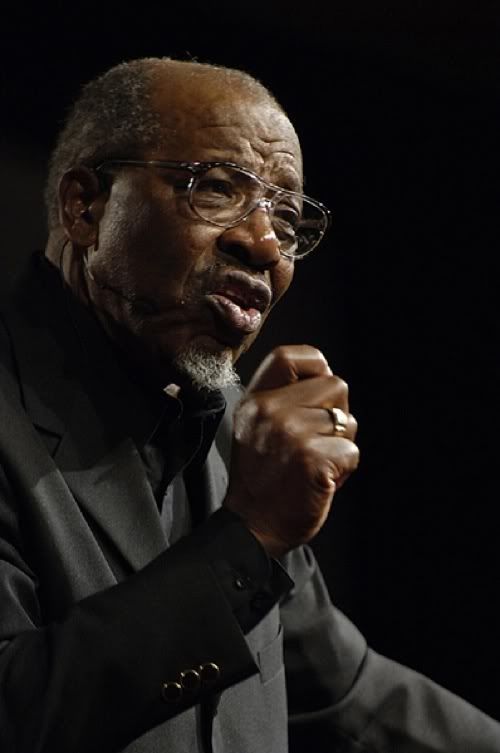 The day closed with a long worship service in which John Perkins was honored with an award for his decades of service to the Christian community. The leaders of Envision 08 said that they have named the award in his honor and will give it to someone following in his footsteps at every future Envision conference. Perkins then gave an impassioned (though at times hard to understand) speech about evangelicals being involved in the issues of poverty and racial reconciliation. After Perkins, Jim Wallis spoke about his experience with evangelicalism and social justice. Unfortunately, I had to leave early, so I did not hear the end of Wallis’s talk nor was I able to partake of the Eucharist. The service was held in the Princeton University Chapel. In the middle of a heat wave and without air conditioning, the service was uncomfortably warm. Even so, it was a fitting close to a remarkable gathering of scholars, ministers, and activists. I look forward with anticipation to Envision 2010.
Tomorrow I will wrap up my summary and review with a note on the learning tracks and some final reflections.
Kamis, 12 Juni 2008
Envision 08: Summary and Review (Part 2 of 3)
The first post in my review of the Envision 08 conference focused on the first day. In this second part of the series, I will summarize and review the second day, minus the evening “night of preaching,” which I was unable to attend.
3. Plenary I: Randall Balmer on the History of Evangelicals
Randall Balmer is a professor of American religious history at Columbia University. His 2006 book, Thy Kingdom Come: An Evangelical’s Lament, is essentially a book-length op-ed about how, as he say, “the Religious Right distorts the faith and threatens America.” I hope to write a full review of the book soon on this blog, but that will have to wait. The point is that Balmer’s talk at Envision was just a summary of some of the more important points in this book. Having read the book already, there was nothing new at all in what he presented. That said, the things he said were good and fit the conference themes.
The major point of his talk comes from the first chapter of his book, regarding what he calls the “abortion myth.” The Religious Right, he argues, did not form in response to Roe v. Wade, as we often hear today. Rather, it formed in response to the government’s rejection of tax exemption for Bob Jones University because of its racist policies (no admittance of blacks for many years, and then no admittance of unmarried blacks in order to prevent interracial marriage). Balmer shows that the Southern Baptist Convention even came out in support of Roe v. Wade three times in the mid-1970s before the fundamentalist takeover of the denomination corresponding with the ascendancy of the RR. In addition to this history of the RR, Balmer also mentioned Roger Williams and the need for true Baptists who maintain the separation of church and state (chapter 2), stated his support for public education as the basis for democracy (chapter 3), highlighted the 2005 debate between Lee Silver and William Dembski over Intelligent Design (chapter 4), discussed the importance of environmental care (chapter 5), and even concluded his talk by reading from the end of his book’s conclusion (pp. 190-91). Overall, Balmer’s talk was well received, but it was disappointing for those of us who wanted more than just a preview of his book. It sounded more like the kind of talk an author might give on a book tour, which perhaps it was, just recycled for Envision 08.
The panel of scholars responding to Balmer included Vincent Bacote, Mimi Haddad, Andrea Smith, and a man who replaced Rita Brock whose name I did not catch. Bacote presented a few questions, but the central one (which he repeated later) was whether the problem with the RR was less a matter of content and more a matter of form. In other words, their concerns might be valid but they go about it the wrong way. Bacote’s question demonstrates his own more conservative politics. Balmer’s critique of the RR includes both form and content, and Bacote did not seem to grasp that point. A more subtle difference between Bacote and Balmer was noticeable in that Balmer was advocating a classically Baptist ecclesiology, whereas Bacote (as a neo-Calvinist) was advocating a Kuyperian-Reformed ecclesiology. Here, again, we have the split between an Anabaptist and a Constantianian understanding of the church. While this difference was not explicit in the conversation, it was nevertheless part of the underlying subtext.
The only other speaker who really made an impact was Andrea Smith, who gave the most stimulating five minutes of the entire conference. She began by describing herself as a Southern Baptist inerrantist with a politics on the “extreme left”! In a frenzy of words, she then went on to dismantle the idea of nonprofit organizations—what she calls the “non-profit industrial complex”—as vehicles for social revolution (their dependency upon government grants makes them incapable of converting and mobilizing people to a cause which has as its goal the subversion of the government) as well as to deconstruct the entire abortion debate. It was a stirring speech, one that I hope will be available in recorded form or at least transcribed.
4. Plenary II: Lisa Sharon Harper on the Theology of Shalom
If there was one major disappointment in the Envision 08 conference, it was the second plenary session with Lisa Sharon Harper. Her presentation of a “theology of shalom” was the event which had the most promise with the least outcome. She began on the wrong foot by doing one of those youth group-like exercises where everyone closes their eyes and imagines something totally far-fetched. She had us imagine a perfect society of love, where there is no Holocaust, no genocide, no Apartheid, no violence, no injustice, etc. When this tiresome exercise was finished, instead of directing us to the vision of the New Jerusalem in Revelation (as I fully expected she would), she said that this is the vision provided by the garden of Eden in Genesis 1-2. The rest of the talk went downhill from there. Harper set about exegeting the description of Eden in Genesis in terms of a “theology of relationality” (my term, not hers; she never really thought theologically at all during her talk). The ish exists in relationship with the isha, the world, and God. Shalom is defined as the wholeness of love-relations that God intends for humanity, but which was ruined with the Fall. She interpreted the tree of the knowledge of good and evil as a reminder to humans that they are to seek God. Temptation is necessary to help spur us on to a deeper relationship with God. The rest of the Story, she said, is about God’s plan of bringing us back to the shalom found in the Garden. That’s basically the summary of her lecture.
What a missed opportunity! I have a long-standing interest in a “theology of shalom,” as demonstrated in my series on the “Spirit of the Lord.” So I came to this presentation with expectations of hearing theology. What we got instead was a presentation of poor exegesis, watered-down theological platitudes, and a gospel of self-realization rather than costly discipleship. Her interpretation of Genesis clearly was not done with any familiarity with the exegetical literature. At several points it seemed that she thinks there was an actual, literal garden; she even said that the garden was bigger than any nation in the middle east today. But my frustration primarily concerns her theology. I will focus my comments on two primary issues: (1) her attempt to return to the Garden rather than move forward to the New Jerusalem; and (2) her reduction of the Fall to temptation.
Throughout her talk, Harper spoke about returning to the Garden—about God bringing us back to the shalom of Eden. Late in her presentation, however, while reading from Revelation, she suddenly caught herself and noted in passing that we are going to a city, not a garden. Rather than dwell on this profound point, she skipped right over it and returned to talking about Eden. The term “New Jerusalem” never once came up. For a brief moment, it was clear that the text completely undermined her “theology of shalom.” And that is because her so-called “theology” was built on a fundamental misunderstanding of the text, one rooted in a conservative evangelical fascination with and interpretation of a literal Eden rather than a christological-eschatological conception of the Holy City. Harper never seemed to realize the contradiction in her identification of the garden of Eden with the kingdom of God. More importantly, her talk revealed that she really had not done her homework: if she had studied Isaiah, Micah, and Revelation, she would have discovered the basis for a theology of shalom rooted in the eschatological hope for the New Jerusalem.
In Micah 4:1-4 (cf. Isaiah 2:2-4), we read that the “mountain of the Lord,” or Zion, will one day “be raised above the hills, and peoples will stream to it.” At Zion, the New Jerusalem, “nation will not take up sword against nation, nor will they train for war anymore.” The nations “will beat their swords into plowshares and their spears into pruning hooks.” These texts are basic to the eschatological doctrine of shalom, but they do not return us to a mythological garden; instead, they point us forward to the future of God, to the time when all the nations of the world are reconciled in the God’s reign of eternal peace (shalom). The concept of the city is a fundamentally political one. Remarkably, in a discussion of “shalom,” Harper never once talked about social and political peace. She only spoke in saccharine terms about human relationships, using the sentimental example of married love, rather than the more daring and biblical notions of ethnic, social, political, and global reconciliation (e.g., Eph. 2). Whereas the garden looks back in nostalgia to a time of arcadian simplicity, the city looks forward to a time of cosmic redemption. Eden is a utopia before conflict, whereas the New Jerusalem is a utopia beyond conflict. Eden is peaceful because there is no sin; the New Jerusalem is peaceful because sin has been destroyed in the cross of Christ and all people now live in the abundant peace of the resurrection. Eden is life before death; the New Jerusalem is life that has conquered death. A theology of shalom grounded in the New Jerusalem is one that recognizes that God in Christ has reconciled the world and is therefore “making all things new” (Rev. 21:5). The eschaton is not a return to some arcadian past; it is a movement toward an open and redemptive future in the light of Christ’s resurrection. A true theology of shalom has to begin from the end, not from the beginning.
Harper’s second major misstep concerns the nature of the rupture of shalom. Since she understands shalom as relationality, sin or the Fall is merely the break in relationship. And since the Fall is reduced to the temptation to turn away from one’s relationship with God, the implication is that salvation is reduced to one’s turning toward God. Her soteriology, if I can even call it that, is almost wholly pelagian and bourgeois. We recover shalom by turning to God and others in love. As long as we do not succumb to temptation but allow such temptation to spur us on to loving relationships, we will recover the shalom of Eden. This is not only a non-christological soteriology—and, not surprisingly, Jesus hardly ever came up in her talk—but it is also a Western, American, bourgeois theology of individual self-realization. According to Harper, I find true wholeness by choosing to love God rather than falling into temptation. The wholeness intended by God in creating the world depends upon whether I choose God or myself. This is an Arminian concept of abstract human freedom which undermines the biblical identification of freedom with obedience. Freedom is not found in choosing God over against choosing something else; freedom is found in following the way of Jesus and becoming a “slave of righteousness,” as Paul says. Freedom is not rooted in my choice of God, but in God’s choice of me in Jesus Christ. Wholeness is not located in what I accomplish, but in what God accomplished for us in the death and resurrection of the Son. Shalom is not found in self-realization, but in God’s actualization of new humanity.
Not only is Harper’s soteriology seriously confused, but her bourgeois theology of self-realization reduces the Fall to temptation when Scripture views it as suffering and death. Genesis 3 is an etiological myth that seeks to explain why humans suffer and die. Harper instead read the story through the lens of human choice and self-actualization. At one point, she mentioned that death and pain are described in Genesis 3 as consequences of the Fall, but she never followed up on that insight. What we see throughout Scripture is not mere temptation, however, but radical oppression and suffering. The slavery in Egypt is the fullest manifestation of the Fall: the Israelites work the ground to no effect, and the women give birth to children slaughtered by Pharaoh. God’s liberation of Israel is the proleptic anticipation of God’s deliverance of the cosmos from the Fall.
By reducing the Fall to temptation, Harper’s “theology of shalom” provides no answer to those seeking liberation in the midst of social injustice, political oppression, and radical evil. But the Bible does have an answer: namely, Jesus Christ, who suffered and died in our place so that we might have confidence that all things are made new in him. Shalom is indeed about relationship: not our relationship with God, but rather God’s relationship with us in Jesus Christ. Wholeness is not found in platitudinous ideas of loving people in the abstract. Wholeness is found in the concrete act of God’s love for us in Jesus, which then overflows into concrete acts of love for others. Harper’s whole message was abstract and individualistic, despite her intention to speak concretely and communally. It was, in the end, closer to the Religion of Oprah than the radical discipleship centered on Jesus.
The panelists—Jeremy Del Rio, Anne Dondapati Allen, Shane Claiborne, Bart Campolo, and Miroslav Volf—did their best to make up for the poor plenary. While each had good things to say, the real fireworks came when Bart Campolo came out and basically denounced Harper’s talk as an example of evangelical platitudes which have no grounding in the real world of ministry to the poor. He said that talk of shalom is all well and good, but it’s all too abstract—and, though I am a theologian who can tend to be abstract, I agree. Campolo went on to say that warm, fuzzy talk about reaching wholeness in our lives has little if anything to do with the hard work of actually loving the poor child suffering from HIV or the woman beaten and raped and desperate for food. These people are not helped by such banal theological assertions.
Campolo’s response was not a plea to give up theology in order to do the “real” work of ministry—far from it! He went on to criticize the way Harper had identified shalom with something the church accomplishes on this earth as it builds the kingdom. By collapsing shalom into some immanent, social reality, Harper failed to address the issue of eschatology, which is my point as well. Campolo said that if wholeness depends upon our ability to build the kingdom here on earth, then those suffering and dying now are left without hope. They can, at best, hope that many generations later we might have built a more just society, but they remain in despair of a hell that threatens to engulf them after death. Campolo then came right out and said that unless our “theology of shalom” can offer hope to people now that they, too, will be included within the kingdom of God—eschatologically understood, of course—our words are empty and vain. In other words, it’s not that we need to drop theology and just feed the poor. Rather, Campolo is saying, unless our theology can grapple with the fact that millions of suffering people are going to die without hearing any good news and tasting any glimpse of the kingdom, we are holding on to a theology that is too distant from the reality of oppression and injustice. His thesis, repeated a few times, is that some theology just will not survive the experience of working with the poor. Being with the poor, he said, warps and twists one’s theology. Just as Shane Claiborne said that his experiences with homosexuals forced him to abandon the traditional views on the matter, so too Campolo said that his experiences with the poor forced him to abandon the notion that you have to believe in the gospel before you die in order to be saved.
I am wholeheartedly in agreement. Harper’s bourgeois theology of wholeness cannot address the person experiencing injustice. She offers no hope to those who are essentially damned from birth, who are born into oppression and will die under oppression—never once having heard a word of comfort and hope. Is a theology of shalom supposed to ignore such people as lost? Are we forced to abandon some in the hopes of creating a new world for others? Or might we instead think christologically and eschatologically about the reign of God, such that it is not dependent upon our ability to realize the kingdom here and now but instead rests in the future of God and thus embraces all people from all times? The visions of Isaiah, Micah, and Revelation are fundamentally universal in nature. I suggest that if Harper had turned to those texts first in articulating a theology of shalom, she might have been able to reach the kind of universal eschatological hope that I and Campolo seek. Campolo tried to assure people by saying that he was not laying a “universalist trip” upon them, but he shouldn’t have backed down from the truth.
Volf responded to Campolo by appealing to Hans Urs von Balthasar’s book, Dare We Hope “That All Men Be Saved”? He said that the church was right not to endorse universalism (I agree), but that we absolutely must have hope that all may be saved. Anything less than that is just unacceptable. Campolo wholeheartedly agreed with Volf. I do, too, but I do not think Balthasar should have the last word on the matter. As I argue here, I think our “Yes” to Balthasar’s question can be stronger than Balthasar’s own “Yes.”
3. Plenary I: Randall Balmer on the History of Evangelicals
Randall Balmer is a professor of American religious history at Columbia University. His 2006 book, Thy Kingdom Come: An Evangelical’s Lament, is essentially a book-length op-ed about how, as he say, “the Religious Right distorts the faith and threatens America.” I hope to write a full review of the book soon on this blog, but that will have to wait. The point is that Balmer’s talk at Envision was just a summary of some of the more important points in this book. Having read the book already, there was nothing new at all in what he presented. That said, the things he said were good and fit the conference themes.
The major point of his talk comes from the first chapter of his book, regarding what he calls the “abortion myth.” The Religious Right, he argues, did not form in response to Roe v. Wade, as we often hear today. Rather, it formed in response to the government’s rejection of tax exemption for Bob Jones University because of its racist policies (no admittance of blacks for many years, and then no admittance of unmarried blacks in order to prevent interracial marriage). Balmer shows that the Southern Baptist Convention even came out in support of Roe v. Wade three times in the mid-1970s before the fundamentalist takeover of the denomination corresponding with the ascendancy of the RR. In addition to this history of the RR, Balmer also mentioned Roger Williams and the need for true Baptists who maintain the separation of church and state (chapter 2), stated his support for public education as the basis for democracy (chapter 3), highlighted the 2005 debate between Lee Silver and William Dembski over Intelligent Design (chapter 4), discussed the importance of environmental care (chapter 5), and even concluded his talk by reading from the end of his book’s conclusion (pp. 190-91). Overall, Balmer’s talk was well received, but it was disappointing for those of us who wanted more than just a preview of his book. It sounded more like the kind of talk an author might give on a book tour, which perhaps it was, just recycled for Envision 08.
The panel of scholars responding to Balmer included Vincent Bacote, Mimi Haddad, Andrea Smith, and a man who replaced Rita Brock whose name I did not catch. Bacote presented a few questions, but the central one (which he repeated later) was whether the problem with the RR was less a matter of content and more a matter of form. In other words, their concerns might be valid but they go about it the wrong way. Bacote’s question demonstrates his own more conservative politics. Balmer’s critique of the RR includes both form and content, and Bacote did not seem to grasp that point. A more subtle difference between Bacote and Balmer was noticeable in that Balmer was advocating a classically Baptist ecclesiology, whereas Bacote (as a neo-Calvinist) was advocating a Kuyperian-Reformed ecclesiology. Here, again, we have the split between an Anabaptist and a Constantianian understanding of the church. While this difference was not explicit in the conversation, it was nevertheless part of the underlying subtext.
The only other speaker who really made an impact was Andrea Smith, who gave the most stimulating five minutes of the entire conference. She began by describing herself as a Southern Baptist inerrantist with a politics on the “extreme left”! In a frenzy of words, she then went on to dismantle the idea of nonprofit organizations—what she calls the “non-profit industrial complex”—as vehicles for social revolution (their dependency upon government grants makes them incapable of converting and mobilizing people to a cause which has as its goal the subversion of the government) as well as to deconstruct the entire abortion debate. It was a stirring speech, one that I hope will be available in recorded form or at least transcribed.
4. Plenary II: Lisa Sharon Harper on the Theology of Shalom
If there was one major disappointment in the Envision 08 conference, it was the second plenary session with Lisa Sharon Harper. Her presentation of a “theology of shalom” was the event which had the most promise with the least outcome. She began on the wrong foot by doing one of those youth group-like exercises where everyone closes their eyes and imagines something totally far-fetched. She had us imagine a perfect society of love, where there is no Holocaust, no genocide, no Apartheid, no violence, no injustice, etc. When this tiresome exercise was finished, instead of directing us to the vision of the New Jerusalem in Revelation (as I fully expected she would), she said that this is the vision provided by the garden of Eden in Genesis 1-2. The rest of the talk went downhill from there. Harper set about exegeting the description of Eden in Genesis in terms of a “theology of relationality” (my term, not hers; she never really thought theologically at all during her talk). The ish exists in relationship with the isha, the world, and God. Shalom is defined as the wholeness of love-relations that God intends for humanity, but which was ruined with the Fall. She interpreted the tree of the knowledge of good and evil as a reminder to humans that they are to seek God. Temptation is necessary to help spur us on to a deeper relationship with God. The rest of the Story, she said, is about God’s plan of bringing us back to the shalom found in the Garden. That’s basically the summary of her lecture.
What a missed opportunity! I have a long-standing interest in a “theology of shalom,” as demonstrated in my series on the “Spirit of the Lord.” So I came to this presentation with expectations of hearing theology. What we got instead was a presentation of poor exegesis, watered-down theological platitudes, and a gospel of self-realization rather than costly discipleship. Her interpretation of Genesis clearly was not done with any familiarity with the exegetical literature. At several points it seemed that she thinks there was an actual, literal garden; she even said that the garden was bigger than any nation in the middle east today. But my frustration primarily concerns her theology. I will focus my comments on two primary issues: (1) her attempt to return to the Garden rather than move forward to the New Jerusalem; and (2) her reduction of the Fall to temptation.
Throughout her talk, Harper spoke about returning to the Garden—about God bringing us back to the shalom of Eden. Late in her presentation, however, while reading from Revelation, she suddenly caught herself and noted in passing that we are going to a city, not a garden. Rather than dwell on this profound point, she skipped right over it and returned to talking about Eden. The term “New Jerusalem” never once came up. For a brief moment, it was clear that the text completely undermined her “theology of shalom.” And that is because her so-called “theology” was built on a fundamental misunderstanding of the text, one rooted in a conservative evangelical fascination with and interpretation of a literal Eden rather than a christological-eschatological conception of the Holy City. Harper never seemed to realize the contradiction in her identification of the garden of Eden with the kingdom of God. More importantly, her talk revealed that she really had not done her homework: if she had studied Isaiah, Micah, and Revelation, she would have discovered the basis for a theology of shalom rooted in the eschatological hope for the New Jerusalem.
In Micah 4:1-4 (cf. Isaiah 2:2-4), we read that the “mountain of the Lord,” or Zion, will one day “be raised above the hills, and peoples will stream to it.” At Zion, the New Jerusalem, “nation will not take up sword against nation, nor will they train for war anymore.” The nations “will beat their swords into plowshares and their spears into pruning hooks.” These texts are basic to the eschatological doctrine of shalom, but they do not return us to a mythological garden; instead, they point us forward to the future of God, to the time when all the nations of the world are reconciled in the God’s reign of eternal peace (shalom). The concept of the city is a fundamentally political one. Remarkably, in a discussion of “shalom,” Harper never once talked about social and political peace. She only spoke in saccharine terms about human relationships, using the sentimental example of married love, rather than the more daring and biblical notions of ethnic, social, political, and global reconciliation (e.g., Eph. 2). Whereas the garden looks back in nostalgia to a time of arcadian simplicity, the city looks forward to a time of cosmic redemption. Eden is a utopia before conflict, whereas the New Jerusalem is a utopia beyond conflict. Eden is peaceful because there is no sin; the New Jerusalem is peaceful because sin has been destroyed in the cross of Christ and all people now live in the abundant peace of the resurrection. Eden is life before death; the New Jerusalem is life that has conquered death. A theology of shalom grounded in the New Jerusalem is one that recognizes that God in Christ has reconciled the world and is therefore “making all things new” (Rev. 21:5). The eschaton is not a return to some arcadian past; it is a movement toward an open and redemptive future in the light of Christ’s resurrection. A true theology of shalom has to begin from the end, not from the beginning.
Harper’s second major misstep concerns the nature of the rupture of shalom. Since she understands shalom as relationality, sin or the Fall is merely the break in relationship. And since the Fall is reduced to the temptation to turn away from one’s relationship with God, the implication is that salvation is reduced to one’s turning toward God. Her soteriology, if I can even call it that, is almost wholly pelagian and bourgeois. We recover shalom by turning to God and others in love. As long as we do not succumb to temptation but allow such temptation to spur us on to loving relationships, we will recover the shalom of Eden. This is not only a non-christological soteriology—and, not surprisingly, Jesus hardly ever came up in her talk—but it is also a Western, American, bourgeois theology of individual self-realization. According to Harper, I find true wholeness by choosing to love God rather than falling into temptation. The wholeness intended by God in creating the world depends upon whether I choose God or myself. This is an Arminian concept of abstract human freedom which undermines the biblical identification of freedom with obedience. Freedom is not found in choosing God over against choosing something else; freedom is found in following the way of Jesus and becoming a “slave of righteousness,” as Paul says. Freedom is not rooted in my choice of God, but in God’s choice of me in Jesus Christ. Wholeness is not located in what I accomplish, but in what God accomplished for us in the death and resurrection of the Son. Shalom is not found in self-realization, but in God’s actualization of new humanity.
Not only is Harper’s soteriology seriously confused, but her bourgeois theology of self-realization reduces the Fall to temptation when Scripture views it as suffering and death. Genesis 3 is an etiological myth that seeks to explain why humans suffer and die. Harper instead read the story through the lens of human choice and self-actualization. At one point, she mentioned that death and pain are described in Genesis 3 as consequences of the Fall, but she never followed up on that insight. What we see throughout Scripture is not mere temptation, however, but radical oppression and suffering. The slavery in Egypt is the fullest manifestation of the Fall: the Israelites work the ground to no effect, and the women give birth to children slaughtered by Pharaoh. God’s liberation of Israel is the proleptic anticipation of God’s deliverance of the cosmos from the Fall.
By reducing the Fall to temptation, Harper’s “theology of shalom” provides no answer to those seeking liberation in the midst of social injustice, political oppression, and radical evil. But the Bible does have an answer: namely, Jesus Christ, who suffered and died in our place so that we might have confidence that all things are made new in him. Shalom is indeed about relationship: not our relationship with God, but rather God’s relationship with us in Jesus Christ. Wholeness is not found in platitudinous ideas of loving people in the abstract. Wholeness is found in the concrete act of God’s love for us in Jesus, which then overflows into concrete acts of love for others. Harper’s whole message was abstract and individualistic, despite her intention to speak concretely and communally. It was, in the end, closer to the Religion of Oprah than the radical discipleship centered on Jesus.
The panelists—Jeremy Del Rio, Anne Dondapati Allen, Shane Claiborne, Bart Campolo, and Miroslav Volf—did their best to make up for the poor plenary. While each had good things to say, the real fireworks came when Bart Campolo came out and basically denounced Harper’s talk as an example of evangelical platitudes which have no grounding in the real world of ministry to the poor. He said that talk of shalom is all well and good, but it’s all too abstract—and, though I am a theologian who can tend to be abstract, I agree. Campolo went on to say that warm, fuzzy talk about reaching wholeness in our lives has little if anything to do with the hard work of actually loving the poor child suffering from HIV or the woman beaten and raped and desperate for food. These people are not helped by such banal theological assertions.
Campolo’s response was not a plea to give up theology in order to do the “real” work of ministry—far from it! He went on to criticize the way Harper had identified shalom with something the church accomplishes on this earth as it builds the kingdom. By collapsing shalom into some immanent, social reality, Harper failed to address the issue of eschatology, which is my point as well. Campolo said that if wholeness depends upon our ability to build the kingdom here on earth, then those suffering and dying now are left without hope. They can, at best, hope that many generations later we might have built a more just society, but they remain in despair of a hell that threatens to engulf them after death. Campolo then came right out and said that unless our “theology of shalom” can offer hope to people now that they, too, will be included within the kingdom of God—eschatologically understood, of course—our words are empty and vain. In other words, it’s not that we need to drop theology and just feed the poor. Rather, Campolo is saying, unless our theology can grapple with the fact that millions of suffering people are going to die without hearing any good news and tasting any glimpse of the kingdom, we are holding on to a theology that is too distant from the reality of oppression and injustice. His thesis, repeated a few times, is that some theology just will not survive the experience of working with the poor. Being with the poor, he said, warps and twists one’s theology. Just as Shane Claiborne said that his experiences with homosexuals forced him to abandon the traditional views on the matter, so too Campolo said that his experiences with the poor forced him to abandon the notion that you have to believe in the gospel before you die in order to be saved.
I am wholeheartedly in agreement. Harper’s bourgeois theology of wholeness cannot address the person experiencing injustice. She offers no hope to those who are essentially damned from birth, who are born into oppression and will die under oppression—never once having heard a word of comfort and hope. Is a theology of shalom supposed to ignore such people as lost? Are we forced to abandon some in the hopes of creating a new world for others? Or might we instead think christologically and eschatologically about the reign of God, such that it is not dependent upon our ability to realize the kingdom here and now but instead rests in the future of God and thus embraces all people from all times? The visions of Isaiah, Micah, and Revelation are fundamentally universal in nature. I suggest that if Harper had turned to those texts first in articulating a theology of shalom, she might have been able to reach the kind of universal eschatological hope that I and Campolo seek. Campolo tried to assure people by saying that he was not laying a “universalist trip” upon them, but he shouldn’t have backed down from the truth.
Volf responded to Campolo by appealing to Hans Urs von Balthasar’s book, Dare We Hope “That All Men Be Saved”? He said that the church was right not to endorse universalism (I agree), but that we absolutely must have hope that all may be saved. Anything less than that is just unacceptable. Campolo wholeheartedly agreed with Volf. I do, too, but I do not think Balthasar should have the last word on the matter. As I argue here, I think our “Yes” to Balthasar’s question can be stronger than Balthasar’s own “Yes.”
Rabu, 11 Juni 2008
Envision 08: Summary and Review (Part 1 of 3)
The Envision 08 conference — or “conversation,” as some Emergent-types prefer — just finished last night, and on the whole I think it was successful, though defining “success” in this context is always a tricky matter. In what follows I will try to offer brief summaries and evaluations of what occurred.1. Some initial general observations
First things first, Envision 08 was blessed with a remarkably broad and extensive list of speakers and participants. The conference sought to be ecumenical by bringing together conservatives, moderates, and liberals (both politically and theologically) around a Common Cause: connecting Christian faith with social and political action. The benefit of this approach was that Envision featured a chorus of different voices, many of whom disagreed with each other. The conference was not simply one group speaking to itself. There were serious differences between various parties, but their overall commitment to the CC almost always counterbalanced the occasional cacophony in the presentations.
The cons of such a rich array of speakers were readily apparent, however. For starters, having so many speakers means that most are unable to speak for any serious length of time; only a few are given a platform to speak at length. Many of the best and brightest were confined to the learning tracks, about which I will say more in a moment. Moreover, because of time limitations due to so many speakers, the occasional cacophony resulting from some presentations was rarely, if ever, oriented in a more positive direction. It was left to individual conversations later to figure out how to reconcile opposing views or decide which view should be rejected. While I want to affirm the ability to openly and honestly disagree, I also want to see real dialogues take place that grapple with the hard issues, and most of the time such conversations were prevented by the moderators. I will discuss some examples of this later.
In addition to the issues surrounding the speakers, there are some general observations to be made about the conference as a whole. The most obvious one certainly dominated everyone’s conversations during the first day—viz. the utter lack of organization. I am not suggesting that the leaders of the conference are entirely to blame, but I will suggest that they failed to take care of many details which are necessary to have a smooth-running conference. The two co-moderators of the conference, Peter Heltzel and Lisa Sharon Harper, are, respectively, a charismatic seminary professor and an artist-activist. While they are both great people, I am not entirely convinced that they have what it takes to put together a conference of this magnitude. I never saw the conference administrator, Ryan Holladay, and when I emailed him a few weeks ago, I never received a response. Sure, he was probably too busy to respond to petty emails, but doesn’t that already indicate an understaffed conference? Sure, the conference was a grass-roots effort put together by volunteers, but shouldn’t that be all the more reason to find volunteers with the requisite organizational and administrative skills for this kind of event? The organizational mishaps are too numerous to discuss here, but they created a general sense of frustration at the start of Envision 08. Thankfully, the sessions themselves were (usually) good enough to help mitigate the frustration.
One final general observation concerns the abysmal use of PowerPoint. In the conference survey, I wrote that whoever was responsible for PowerPoint should be fired—and I meant it. Not only were the slides—apart from the Emerging Church forum—poorly designed, but the person running the program had no idea what he or she was doing. The person was also using a PC with only one monitor, which means that in order to go forwards or backwards, one has to scan through all the slides. (The Mac version has a feature that allows one to pick and choose which slide to show, a feature that is not available on Keynote, unfortunately.) In any case, it was very distracting and, quite frankly, an embarrassment to those in attendance who paid anywhere from $49 to $249 to attend and should expect such simple technological issues to be flawless.
2. Opening session: Rich Cizik, Jeanette Yep, and Shane Claiborne
The opening session on Sunday night was hit-and-miss, as was most of the conference. The evening began with some rather uninspiring worship—uninspiring, in part, because of the dismal PowerPoint, which completely ruined my attitude of worship. Rich Cizik, vice president of the National Association of Evangelicals, was the first to speak. He presented a message that was, for the most part, entirely incoherent and disorganized. He seemed comfortable in front of the crowd but very uncomfortable and hesitant about his message. It took him a good while before he finally started talking about the environment, which is the issue for which he is so widely known in the evangelical world. For the most part, he just stumbled from one loud assertion to another without any discernible (or at least intelligible) transitions. Afterwords, a guy said to me that he was surprised Cizik was actually a lobbyist in Washington, because on the basis of his performance that night, it would seem to indicate a total inability to communicate. I would say he only began to speak coherently in the last five or ten minutes of his half-hour talk.
Overall, Cizik wasted a huge opportunity. He could, and should, have discussed the changing culture of American evangelicalism. As one who is friendly with both traditionalists and progressives, Cizik is in a unique position to talk about the recent developments within the evangelical ranks. He could also have presented a discussion of the issue of climate change and global warming. He mentioned it, but said nothing of substance about the issue, except to say that evangelicals now realize the importance of caring for the creation. Why not talk about how younger evangelicals might advance the conversation about creation? Why not discuss how environmentalism has been embraced by evangelicals who formerly viewed it as the sole possession of the political left? And why not suggest how this trend might be replicated in other situations? Cizik mentioned his collaboration with scientists. Why not suggest ways of understanding the relationship between scientists and evangelicals in the 21st century? These would all have made excellent topics for discussion, but his presentation was, instead, full of energy but empty of content. It almost seemed like he was charged with giving a pep talk to us. If so, then the organizers are to blame for his disappointing message.
After Cizik came Jeanette Yep. I’ll be honest here. I remember liking what she said, but I cannot for the life of me remember a single thing that she said. Maybe others can. All I know is that it was forgettable. But I have a bad memory. (Update: Thanks to Chris for reminding me of her talk.)
Finally, Shane Claiborne took the stage. I have deep respect for Shane and his work in inner-city Philadelphia (his new book, Jesus for President is amazing), and I have even more respect after hearing him speak over the past few days. Shane, like Rich Cizik, gave more of a pep talk than an actual presentation. But while Rich was convoluted, Shane was prophetic. He talked about how Jesus, when asked if he was the messiah, never answered the question but responded by simply asking, “What do you see?” Shane then said, if people asked us whether we are Christians, could we actually say with integrity, “What do you see?” It was a powerful message, and he almost single-handedly saved the evening. A key difference between Claiborne and Cizik is the relationship between Christians and political power. Cizik is a Washington lobbyist who directly appeals to government authority and power as the basis for effecting change. Shane, on the other hand, on the basis of his Anabaptist ecclesiology, sees the ecclesial community as the place where God’s kingdom is embodied. The church has no need for political power; instead, it witness to God’s reign through powerlessness, through servanthood, through the cross.
At the end of the day, Shane Claiborne understands that the gospel calls us to radical discipleship (he appealed to Bonhoeffer’s notion of “costly grace”). Rich Cizik, by contrast, seems to think that the gospel calls us to radical effectiveness by any means necessary. Cizik and Claiborne may support similar issues—they both advocate adjusting to a post-oil world—but they do so in fundamentally different ways. A major fault of the conference is that it never addressed this dissonance head on. Consequently, at the heart of the conference was a major contradiction—one that can be summarized in terms of whether one adopts an Anabaptist or Constantinian ecclesiology. If Envision 2010 has any hope of success, it must address this issue directly. We cannot cover up this issue through pleasant platitudes. The church must face this problem honestly and openly if it wishes to speak prophetically in the world today.
The opening session closed with a brief discussion by Rita Brock of the eucharist and its relation in the early church to the miracle of the feeding of the 5000 with the loaves and fishes. The entire conference was framed as one long eucharistic liturgy. This was an excellent idea, though a lot more could have been said about this. William Cavanaugh’s work comes to mind, for example.
Finally, after some more worship music, the evening closed with a “Christian” hip-hop/rap duo that was unnecessary and embarrassing. The act had no connection with anything else at the conference and it nearly ruined the otherwise positive vibe left by Brock’s explanation of the eucharist. Much of the evening felt like an attempt to fit as many different things into one evening as possible. Unfortunately, the PowerPoint problems, the worship band, the hip-hop act, Cizik’s message, and the consistently bad transitions throughout the evening left an overall sour taste in the mouth. We were left hoping for something better on Monday morning—but the worst (and best) was yet to come. More on that tomorrow.
Jumat, 09 Mei 2008
Envision '08: The Gospel, Politics & the Future
On June 8-10, one of the largest evangelical conferences in American history will be held at Princeton University. Entitled Envision '08, the conference is an attempt at uniting Evangelicals and mainstream Christians together in a conversation about how the gospel and politics interrelate in the current American context. The conference will feature around 60 speakers, including the following:
If you are in the Philly or New York area, I highly recommend coming to the conference. More importantly, while the regular registration rate is $249, it will be $99 until tomorrow at midnight EST. Sign up now, if you have an interest in coming. See you in June.
- Randall Balmer
- Rich Cizik
- Shane Claiborne
- Brian McClaren
- Miroslav Volf
- Jim Wallis
- Vincent Bacote
- Bruce Benson
- David Gushee
- John Perkins
- Ron Sider
- Christian Collin Winn
- Arts for Transformation - Explore how faith and arts can be a way to inspire and lead social transformation and learn how to create such art. Led Bruce Herman & Lara Scott.
Beyond Consumerism - Discover how faith can help us live simply out of care for our neighbor and the earth. Led by Ron Sider.
Caring for the Earth - See what we all can do to care for creation and address climate change and other environmental problems. Led by Alexei Lauschkin.
Evangelicals and Empire - Learn how faith helps us to resist the principalities and powers of the world and calls us to work for the Kingdom of God. Led by Bruce Ellis Benson and Christian Collin Winn.
- Evangelism and the World - Explore how the good news and God’s love can address the needs and injustices of the world. Led by Vincent Bacote & John Tyson.
If you are in the Philly or New York area, I highly recommend coming to the conference. More importantly, while the regular registration rate is $249, it will be $99 until tomorrow at midnight EST. Sign up now, if you have an interest in coming. See you in June.
Langganan:
Postingan (Atom)