Jumat, 25 Mei 2007

The Spirit of the Lord, §4.5: God in the Abyss

Fifth, and finally, Jesus Christ is the promised Messiah who came to accomplish the work of redemption which only he could accomplish. Consequently, his coming is no Gnostic liberation from our physical bodies or from the material world itself; rather the coming of God in Jesus Christ is a messianic liberation which, in accordance with the whole biblical witness, encompasses the fullness of our creaturely reality. The advent of Christ embraces, disrupts, liberates, renews, and proleptically resurrects the whole realm of created being; no aspect of our actuality, no matter how nugatory, is neglected by the interruptive presence of God with humanity. Immanuel is a divine being-with the ignored, the abandoned, and the oppressed. The advent is a divine ‘option for the poor,’ a messianic embracement of those who are disappeared by the world. Immanuel is ‘God with us,’ but especially with those whom society overlooks, who have no entitlement to divine attention, who linger on the edge of nothingness. Immanuel is God in the abyss.

This is nowhere more evident in Scripture than in the cry of abandonment by Jesus on the cross before he died (Matt. 27:46; Mk. 15:34). Some have tried to lessen the weight of these words by noting that Jesus is quoting the opening line of Psalm 22. Because this psalm ends with a statement of confidence in God, perhaps Jesus actually means to imply his confidence in God the Father. If that is indeed the case, one must wonder why Jesus does not quote from a more confident psalm, like the opening line of Psalm 21, “In your strength the king rejoices, O LORD,” or the opening of Psalm 23, “The LORD is my shepherd, I shall not want.” But Jesus chooses Psalm 22 to express his suffering on the cross.

In order to rightly interpret the cry of Christ on the cross, we must understand the mission of the Jesus as the sole unique mediator between God and humankind. In the mystery of the cross, we encounter the mystery of reconciliation between a loving God and a God-forsaken world. In Genesis, God commands the first humans to not eat of the tree of knowledge, saying, “for in the day that you eat of it you shall die” (Gen. 2:17). But when they do eat of this tree, they continue to live. They don’t die, at least not biologically. Instead, they are exiled from the garden and sent out into a world bereft of God’s presence. This is true death, spiritual death. It is death in God-forsakenness. And it is into this God-forsaken world that Jesus came to live and die in order that we might have life—true life, eternal life. So we read in Romans 5 that “sin came into the world through one man, and death came through sin . . . Therefore, just as one man’s trespass led to condemnation for all, so one’s man act of righteousness leads to justification and life for all” (Rom. 5:12, 18).

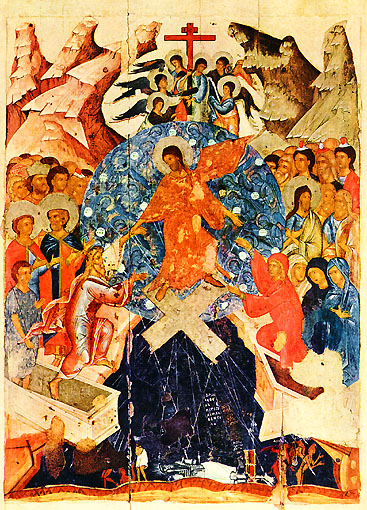
But there is still more to be said. The spiritual death that entered through Adam is what some have called the “second death.” The first death is biological, but the second death is spiritual. In the first death, we descend into the earth. In the second death, we descend into hell. The God-forsaken world of death into which Jesus came as our savior is a world falling over the edge into the abyss of hell. And on the cross, when Jesus cried out to God, we come to understand that Jesus has not only defeated the first death, but the second death as well. The death of Christ is the death of death. As Paul writes in 1 Corinthians, “as all die in Adam, so all will be made alive in Christ” (1 Cor. 15:22). Unlike us, who descend into hell and are helpless to escape, Jesus Christ went to the fullest depths of hell in order to rescue us, in order to liberate us from our bondage to sin and death. This is what we confess when we say, along with the creed of the church, “He descended into hell.” In the cry of God abandonment, Jesus confirmed that he died in the place of the greatest sinner in order to rescue even this one from hell’s grasp. In his death in God-forsakenness—as one abandoned by God—he accomplished our freedom from God-forsakenness, our adoption as the children of God.

As we know all too well, however, in the absence of God’s presence, hell makes its presence felt all too often in this world. But the power of the cross extends even here. In his death in God-forsakenness, Jesus died in solidarity with those who felt forsaken in the death camps at Auschwitz, in the killing fields of Cambodia, in the lynchings here in the United States. On the cross, Jesus went to the very depths of forsakenness. He descended into the abyss. He experienced the darkness of damnation, the horrors of hell. But precisely here the mystery of the cross is demonstrated most vividly, in that Jesus not only died in the place of the ones tortured and murdered; he also died in the place of the torturers and murderers. Jesus demonstrated the extent of God’s love in that he died the death—the second death—of all sinners. “While we were still sinners, Christ died for us” (Rom. 5:8). His death is the death of all death. His descent into hell is the destruction of hell. In the cross of Christ, in his death in God-abandonment, “the power of Hell is already broken (down), the locked door of the grave is already burst open” (von Balthasar).

Rabu, 23 Mei 2007

“As Barth”: A Poetic Challenge

I have a challenge to give to theo-bloggers with a creative side. It involves the following poem, “As Calvin,” written by Albert Piersma and published in The Calvin Forum II:2 (1936), p. 39.
As Calvin

Make of me no Calvinist,
God of Calvin and of me,
Cause me not to follow him
Who would follow only Thee.

Make of me no Calvinist,
Swallowing each word he penned,
Make of me a thinker, God,
As was he, Thy intimate friend!

Make me, God, as Calvin was,
Now, while yet in days of youth,
Delving from the Depths of Thine,
Sovereign, soul-exalting truth.

Make me like the Christ, O God,
Give me not a Calvin's ire,
But withhold from me the spark
For a new Servetus-fire.

Make me like a Calvin, God,
Just as humble, just as brave,
Like a Calvin who refused
E'en a stone upon his grave.

--Albert Piersma
So here is the challenge: write a poem like this, but about Barth instead of about Calvin. In other words, it should follow the basic form: Make of me no Barthian . . . Make me like a Barth. The poem need not be five stanzas, but it should at least get the essential aspects. I will publish all submissions on my blog, and at the end there will be a poll for people to vote on whose poem is the best.

Are you willing to give it a shot? The contest will be open until July 4, which is six weeks from today. All submissions should be emailed to me. My address is available by clicking on the link to my complete profile. Let the writing begin!

First update: I received 16 excellent entries for the contest! Here are the links to each one:

Wildcard Entry: “As Christ” - Aric Clark
Entry #1: “As Barth” - Dan
Entry #2: “As Barth” - Theodora Hawksley
Entry #3: “As Calvin, not Barth” - Guy Davies
Entry #4: “Three Haiku on Barth” - Kerry Walters
Entry #5: “An Ode to Clarity” - Jon Mackenzie
Entry #6: “Barth’s Grandeur” - Ben Myers
Entry #7: “Not I But Christ” - Charles Cameron
Entry #8: “As Charles Wesley” - Richard Hall
Entry #9: “As Barth” - Chris Tilling
Entry #10: “Four Limericks on Karl Barth” - Kim Fabricius
Entry #11: “Make of Me No Barthian” - Peter Kline
Entry #12: “The Tome of Barth weighs down my head” - Mykel Larson
Entry #13: “Barth & Rumi Advise the Theologian” - Ann Chapin
Entry #14: “As Barth” - Michael Pailthorpe
Entry #15: “Bonhoeffer Argues with Barth Over Heaven and its Songs” - David Wright

Second update: After two rounds of voting, Ann Chapin took home the “As Barth” prize. David Wright and Kim Fabricius were the two runners-up. Many thanks to everyone who entered the contest!

Senin, 21 Mei 2007

The Spirit of the Lord, §4.4: Munus triplex

Fourth, Jesus Christ’s work of reconciliation is not only forensic but also ontological and moral. This thesis regarding the doctrine of the atonement summarizes the previous theses by explicating the work of Christ according to the three categories of forensic, ontological, and moral: (1) as a forensic transaction in which the Christus Vicarius bears the divine judgment upon our sin so that we might be pronounced righteous extra nos in him; (2) as an ontological event in which the Christus Victor destroys our ontic estrangement from God and corresponding bondage to sin so that we might become new creatures who exist in union with God; and (3) as a moral example in which the Christus Magister exemplifies divine love and forgiveness so that we might live in moral correspondence to his prototypical life in the Spirit. The Protestant tradition emphasizes the forensic dimension over the others, sometimes exclusively, and thus often obscures the interrelation between the three ways of interpreting the reconciling work of Christ. A solely forensic account of atonement will tend toward a strictly spiritual interpretation of Immanuel and miss the ontological and moral implications of Christ’s advent. An account of the atonement, therefore, which holds all three understandings together will be superior to any one of the accounts singled out on its own.

While it is not our concern here to present a constructive doctrine of the atonement, it will be sufficient to point out the implications of understanding the reconciliation accomplished in Jesus Christ in ontological and moral terms, in addition to forensic. To put it simply, the primary implication is that our whole being is involved in the event of reconciliation. Our ontological identity and moral activity are defined by the actuality of the atonement in Jesus Christ. “So if anyone is in Christ, there is a new creation”: in the coming of Immanuel the new reality of resurrection irrupts into the world as a proleptic event which is constitutive of the reality of those who are “in Christ” by virtue of God’s election of humanity into the covenant of grace. Our very identity—understood in ontic and ethical terms—is defined by the event of Jesus Christ. What Christ accomplished in his life, death, and resurrection determines not only our status before God, but also our being and our life, both of which are brought into correspondence to God in him.

The munus triplex outlined above and central to Reformed dogmatics provides an essential framework for interpreting the reconciliation accomplished in Jesus Christ in terms that are forensic, ontological, and moral. The legal or forensic imagery which is at the heart of Western theology focuses primarily on Christus Vicarious: Christ as the High Priest who, according to the author of Hebrews, accomplishes the once-for-all sacrifice for sins on the cross in the place of humanity. The sacrifice of Christ is generally spoken of in forensic terms as the establishment of sinful humanity’s justification before God. According to Paul, “For while we were still weak, at the right time Christ died for the ungodly. . . . God proves his love for us in that while we still were sinners Christ died for us. Much more surely then, now that we have been justified by his blood, will we be saved through him from the wrath of God” (Rom. 5:6, 8-9). The Eastern tradition, however, tends to focus on Christus Victor: Christ as the King who liberates enslaved humanity from the powers of sin and death. The emphasis is not on a legal transaction but on an ontologically new reality; humanity is redeemed from its enslavement and freed for a new existence as the children of God. The final aspect of Christ’s atoning work is traditionally expressed by the Christus Magister: Christ as Prophet who proclaims a new way of life which does not negate the law and the prophets but instead fulfills it. Christ inaugurates a moral framework controlled by love of God and love of neighbor—and not just love of one’s neighbor, but in fact love of one’s enemy.

The munus triplex has been critiqued by numerous theologians from Schleiermacher to Barth to Pannenberg. But regardless of the merits of these criticisms, the “threefold work of Christ” remains an important reminder both of the multivalent nature of the atonement—forensic, ontological, and moral—and of the close connection between Christ’s once-for-all sacrifice on the cross and the Old Testament sacrifices of Israel. The former ensures that we do not reduce the cross to a legal transaction which has no necessary impact upon our being or our lived existence. The latter ensures that we do not disconnect the cross from its historical-cultural moorings in the Hebraic understanding of sin, sacrifice, and atonement. The importance of this rootedness in the Hebraic tradition is felt especially in the concern of this essay: that we cannot understand the peace of Christ, the peace of Immanuel, apart from the Israelite context in which the prophecy of this Prince of Peace was made known to God’s chosen people. We cannot speak of the shalom which Christ accomplished in his death and resurrection as if it is unrelated to the ontic and ethical dimensions of human existence, or as if it is unrelated to the Hebraic conception of atonement found through the Old Testament scriptures. The munus triplex provides a way of speaking about Christ’s atoning work that takes the Old Testament into consideration, and this is an essential component in combating modern Gnosticism.

Barth: theology is for the whole church

[H]ow disastrously the Church must misunderstand itself if it can imagine that theology is the business of a few theoreticians who are specially appointed for the purpose, to whom the rest, as hearty practical men, may sometimes listen with half an ear, though for their own part they boast of living “quite untheologically” for the demands of the day (“love”). As though these practical men were not continually preaching and speaking and writing, and were not genuinely questioned as to the rightness of their activity in this regard! As though there were anything more practical than giving this question its head, which means doing the work of theology and dogmatics! Again, how disastrously the Church must misunderstand itself if it can imagine that theological reflection is a matter for quiet situations and periods that suit and invite contemplation, a kind of peace-time luxury for which we are not only permitted but even commanded to find no time should things become really serious and exciting! As though there could be any more urgent task for a Church under assault from without than that of consolidating itself within, which means doing theological work! As though the venture of proclamation did not mean that the Church permanently finds itself in an emergency! As though theology could be done properly without reference to this constant emergency! Let there be no mistake. Because of these distorted ideas about theology, and dogmatics in particular, there arises and persists in the life of the Church a lasting and growing deficit for which we cannot expect those particularly active in this function to supply the needed balance. The whole Church must seriously want a serious theology if it is to have a serious theology.
—Karl Barth, Church Dogmatics I/1, trans. G. W. Bromiley (Edinburgh: T. & T. Clark, 1975), 76-77.

Jumat, 18 Mei 2007

Recap of the spring 2007 semester

In my return to blogging after a hiatus due to finals, I would like to recap my semester in terms of the most important insights I gained theologically or academically. The spring 2007 semester brings my second year at Princeton Theological Seminary to a close, during which I co-helmed the editorship of the Princeton Theological Review, presented a paper at the regional AAR meeting, and took many more theologically stimulating courses from some of the great professors at this institution. In the midst of this environment, here are just three of the things I learned over the past several months:

1. The centrality of theological exegesis for the church today. Two of the courses that I took this semester dealt with relation between systematic theology and biblical exegesis—one in terms of how Karl Barth’s Epistle to the Romans holds up in light of scholarship on Paul’s epistle to the Romans, and the other examining Galatians with an eye toward theological scholarship. These two courses revealed two important things for me: first, that I love theological exegesis, and second, that theological exegesis is of central importance for the church today. The former was clear in how much I enjoyed writing my papers for those two courses, but the latter is much more significant. The church today suffers from a lack of biblical knowledge and a complacency regarding the core doctrines of the church. The Bible has become a dead letter due to the failure of churches to ground their identity in the gospel, and theology has become a dead letter due to the failure of theologians to escape from the academic ghettoization of theology. Theological exegesis holds a lot of promise for the church as an enterprise which seeks to reinvigorate examination of the Bible without losing sight of the central dogmas of the church. At the same time, theological exegesis engages in rich theological exposition while attending to the texts that shape the life of the church community. Hopefully, the current interest in theological exegesis is a sign of great things to come.

2. The significance of Schleiermacher today. A course on Schleiermacher this semester with Bruce McCormack was especially instructive. It is difficult to read Barth without understanding Schleiermacher, and this course was particularly helpful in elucidating the central theological insights of the great Berlin theologian. It was helpful to see how Schleiermacher upholds the insights of Chalcedon while dismissing Nicaea, how he grounds election in a single, eternal divine decree (anticipating Barth’s later christological grounding of election), how he dialectically interrelates the natural and the supernatural, and how his system expands upon his basic foundation in the feeling of absolute dependence (not always consistently, as his doctrine of creation demonstrates). For me, especially, having grown up in American evangelicalism, the connections to Schleiermacher’s theology are manifold, and hopefully I will have a chance to explore these later.

3. The ecumenical possibilities in a theology of the eucharist. I truly enjoyed my course on the eucharist with George Hunsinger, where we explored the ecumenical possibilities of a theology of the Lord’s Supper which seeks to faithfully uphold the central insights of the major traditions in the Christian church. The course was both historical and systematic, and throughout we sought to identify the key elements of each tradition in order to see how they cohered with other articulations of the eucharist. In the end, we went back to the Reformers—Peter Martyr Vermigli, in particular, but Luther and Calvin as well—to uncover some obscure connections with Orthodox sacramentology which may prove to be ecumenically fruitful. In the end, I find myself quite optimistic about the theological possibilities, but much less optimistic about the ecumenical possibilities. In my study of Hans Urs von Balthasar for this paper, and having read some thoughts by Orthodox leaders, it is clear that simply articulating a theological position on the eucharist which is acceptable to all will not bring about a common table—though I can certainly hope and pray that such a theology will be the first step toward such a reality.

Selasa, 08 Mei 2007

Finals

My absence from blogging as of late is a consequence of the fact that I am in the midst of finals. But the end is in sight. Less than a week and I will be finished.

There will be much rejoicing. (And blogging.)

Kamis, 03 Mei 2007

The Spirit of the Lord, §4.3: Yes and No

Third, while Jesus Christ frees us from sin, guilt, and death, liberation is always a dialectical event. Freedom is always freedom-from and freedom-for: from the No and for the Yes, from the old and for the new, from the past and for the future, from sin and for righteousness, from death and for life. Freedom from our bondage to sin results in freedom for our bondage to righteousness. Freedom from sin results in freedom for obedience. Now that we are new creatures, God calls us to live new lives. Now that “there is a new creation” and “everything has become new” through the reconciling work of Christ, God implores us: “Be reconciled to God!” (2 Cor. 5:17, 20). The life, death, and resurrection of Jesus thus has important and necessary ramifications for the shape of our life here and now on earth. We are called to be “a royal priesthood, a holy nation, God’s own people” (1 Pet. 2:9). We are commanded to present our bodies to God as “a living sacrifice” (Rom. 12:1). We are no longer slaves to sin, but instead we are now “slaves of righteousness” (Rom. 6:18). We no longer belong to ourselves but to God alone.
We are not our own: let not our reason nor our will, therefore, sway our plans and deeds. We are not our own: let us therefore not set it as our goal to seek what is expedient for us according to the flesh. We are not our own: in so far as we can, let us therefore forget ourselves and all that is ours. Conversely, we are God’s: let us therefore live for him and die for him. We are God’s: let his wisdom and will therefore rule all our actions. We are God’s: let all the parts of our life accordingly strive toward him as our only lawful goal. (John Calvin, Institutes 3.7.1)
Any attempt to sever freedom-from and freedom-for, or emphasize one to the exclusion of the other, imposes a dualism where a dialectical tension ought to exist. The No and the Yes necessarily belong together; a negation demands a corresponding affirmation. And in the word of the cross, we find that God’s No and God’s Yes are the same divine event of love in Jesus Christ. The No of judgment is circumscribed by the Yes of grace; the negation of sin is enveloped within the affirmation of new life. God was in Christ for the purpose of bringing about a positive act of new creation while negating the forces of sin and evil. To put it another way, in the cross of Christ, God negated the negation of sin, thereby accomplishing the positive reality of reconciliation. Consequently, the communion of saints (communio sanctorum) lives as a community shaped by this positive new actuality. The church is the community of those liberated from sin and death for a new existence defined by righteousness and life.